From Spectator to Player: A Father's Emotional Journey
The first memory that comes to Satya Krishnamurthi's mind isn't of a practice session, a trophy, or a highlight-reel moment. It's a vivid recollection of sitting in the stands at Bengaluru's M Chinnaswamy Stadium with his eight-year-old son, watching India battle New Zealand in a Test match. The young boy absorbed everything—the electric crowd, the crisp white uniforms, the rhythmic pace of a full day's cricket.
Then came the defining moment: Trent Boult troubling Sachin Tendulkar, followed by Tim Southee clean bowling the Master Blaster. Satya remembers the palpable disappointment on the faces of fans and, most poignantly, on his cricket-obsessed son's face.
A Dream Realized at Wankhede
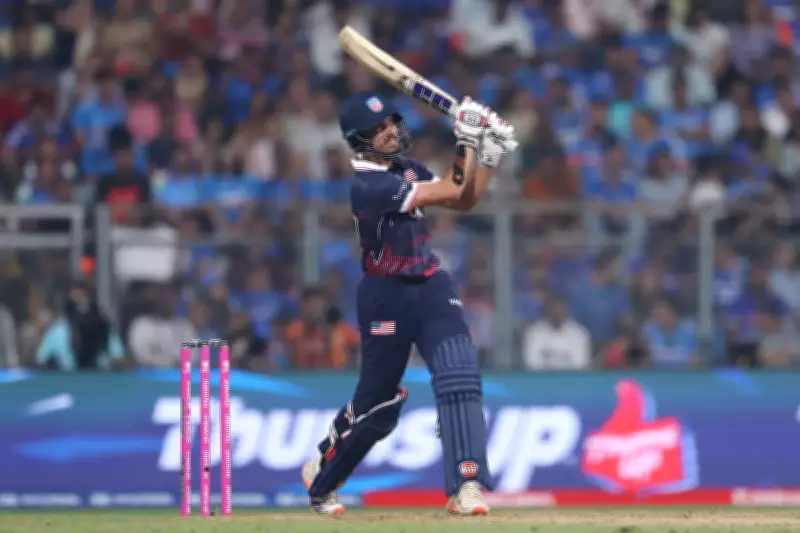
Years later, at Tendulkar's home ground—the iconic Wankhede Stadium—that same son, Sanjay, now 22, smashed monstrous sixes off Hardik Pandya and Axar Patel. The entire stadium erupted in applause for the young American cricketer, with veteran spinner R Ashwin showering praise on social media. Watching from the stands, Satya was overcome with emotion.

"We couldn't even believe what we were seeing," Satya told TimesofIndia.com. "It was way beyond what we had dreamt he would be doing."
Satya grew up like most Indian children of his generation: playing casual cricket and watching plenty of it, but never seriously considering it as a career path. When Sanjay showed early promise, there were no grand master plans—just encouragement, support, and letting the child enjoy the game naturally.
The Seed Planted by 2011 World Cup
India's triumphant 2011 World Cup victory planted a seed in young Sanjay. Recognizing their son's passion, Satya and his wife Julie—an American citizen—made the significant decision to relocate to Bengaluru. Their goal was simple: to provide Sanjay with the environment to pursue his cricketing dream.
At Bengaluru's Ebenezer International School, Sanjay found mentorship in coach Syed Zabiulla, who has also guided US cricketer Rushil Ugarkar and Karnataka's current batting sensation R Samaran. Interestingly, during his school days and even while playing for Karnataka Under-16, Sanjay wasn't known as a power-hitter.
His role was that of a classical anchor: building innings steadily, providing stability, and accumulating runs without flashy strokeplay.
The Pandemic Pivot to American Shores
Sanjay's cricketing journey took an unexpected turn in March 2020 when the family moved from Bengaluru to San Francisco's Bay Area, right as the pandemic gripped the world. The transition was monumental—exchanging a nation where cricket breathes in every alley for a country where the sport was still establishing its roots.
"In India, everything takes effort," Satya explains. "The traffic, the travel, the intense competition. In the US, some logistical aspects are easier. Infrastructure for movement is better, but from a cricketing perspective, facilities are fewer."
Yet cricket was quietly growing in America. In the Bay Area, Satya began noticing parents dropping their children at academies during evenings and weekends. Matches were being organized regularly. The ecosystem remained small but was steadily expanding—enough for Sanjay to continue playing, adapting, and evolving.
Reinvention in a Single-Format Environment
What proved crucial was Sanjay's temperament. According to his childhood coach, he was never a loud presence. The move to the US brought a harsh cricketing reality: no red-ball cricket, no multi-day games. White-ball cricket dominated completely.
"Sanjay understood something very early," Zabiulla recalls. "If you want to play here, you have to change."
Sanjay later confided to his coach that the quality of cricket in India was higher. However, the US's single-format focus simplified planning while demanding reinvention. Strength was lacking; boundary-hitting became essential. So Sanjay dedicated himself to transforming his game.
The metamorphosis wasn't overnight but was deliberate and determined. The anchor learned how to finish innings. The boy who once struggled to clear boundaries evolved into a player capable of changing games with powerful swings.

Balancing Cricket with Computer Science
Throughout this transformation, academics remained a priority. Sanjay is pursuing a bachelor's degree in Computer Science and is currently in his final year. Juggling coursework with international travel presents significant challenges—he still has four courses remaining to complete his degree.
"He's very good at studies," Satya says. "That's something you can manage in the US, which is very difficult in India. But he is finding it tough to balance both. Some professors are very supportive when he's travelling, and online options help him manage. Now that he's playing in the World Cup, people are praising him."
Satya believes this balance would have been far more challenging in India's rigid academic system. In the US, flexibility exists despite heavy demands.
Rising Through Global T20 Leagues
When Sanjay began featuring in T20 leagues—first in the US, then abroad—attention followed naturally. For the past two years, he has played in Major League Cricket (MLC). This year, he also participated in the Nepal Premier League and the ILT20. Dressing rooms changed; standards elevated as he trained alongside some of the world's best cricketers.
Yet one milestone remained elusive: playing against India's finest. When that moment finally arrived at Wankhede Stadium, emotions overwhelmed his parents.
"Just after the match, so many people messaged me," Satya shares. "Hundreds of messages for me, my wife, and him. It took time to respond to everyone."
Celebrity was never part of the plan—it arrived quietly, then all at once. Satya admits he didn't expect it to be this monumental, even after years of understanding sports culture.
The Underdog Mentality That Shaped Him
Zabiulla, watching from afar, wasn't surprised by Sanjay's composure. He had witnessed it before during a crucial two-day school match against DPS South, a team boasting ten state-level players. Zabiulla's team had just one.
"As a coach, I was tense," he recalls. "It was a small ground. They could have scored 300 or 400."
Instead, careful planning and disciplined execution turned the tide. The opposition was bowled out for 140. Sanjay contributed with a tight spell of left-arm spin and provided a solid start with the bat. When the top order collapsed at 80 for 5, collective belief carried them through. The tail wagged; they qualified for the finals.
There was a celebration at Sanjay's house that night—not because they had discovered a future international star, but because a group of underdogs had trusted a plan and each other.
Admiration for AB de Villiers and Beyond
That mindset stayed with Sanjay as he matured. He analyzed everything around him, listened more than he spoke, and learned when to adapt versus when to stay true to himself.
Even his cricketing idols were chosen thoughtfully. Sanjay grew up admiring AB de Villiers—not to imitate him, but to appreciate genius.
"The cricketer he really looks up to is AB de Villiers," Satya reveals. "In a recent interview, he said he doesn't think his game resembles AB's because AB is a genius who can't be replicated. But he has always looked up to him."
Satya, when asked to choose between Sachin Tendulkar and Rahul Dravid, laughed before selecting Dravid—not for statistics, but for personality. Perhaps this explains something about Sanjay's own character.
Living in the Present, One Ball at a Time
For Satya, it's always about the next game, not past applause. For Zabiulla, it's about a boy who understood his environment's demands and adapted accordingly. And for Sanjay, it remains about living in the present—one ball at a time—carrying the image of MS Dhoni's World Cup-winning six, a shot that brought joy to billions and hope to one young boy.