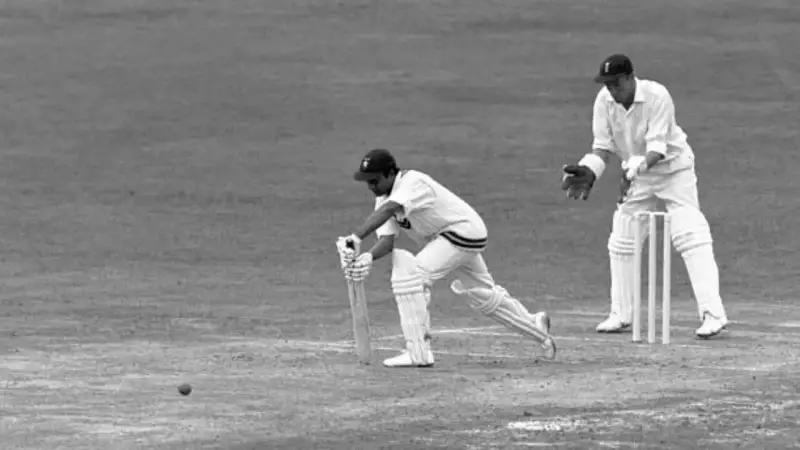
Long before the era of Imran Khan's leadership, Wasim Akram's swing, or Shoaib Akhtar's pace, Pakistan cricket found its first true hero in a diminutive batter named Hanif Mohammad. In a nation freshly carved out on the map, searching for an identity, Hanif provided one with his bat, transforming cricket from an elite pastime into a street-corner passion for millions.
The Foundation of a National Obsession
Born on December 21, 1934, in Gujarat in undivided India, Hanif Mohammad's destiny shifted with the Partition. His family moved to Pakistan, and with it, the future of the country's cricket. He became a central figure in Pakistan's inaugural Test match against India in 1952, embarking on a 17-year international career that would yield 3,915 runs in 55 Tests at an average of 43.98.
His statistics, however, are merely a footnote to the legend. Standing at just 5 feet 3 inches, the 'Little Master' announced himself not with brute force but with immense concentration and time. His first-class debut at age 16 during an unofficial Test against the MCC in Lahore in 1951 left seasoned observers astonished. Fast bowler Brian Statham famously remarked he looked about 12. Yet, by scoring a painstaking 26 in 165 minutes, and a crucial 64 in the next match, the teenager signalled the arrival of a unique talent who would become the bedrock of Pakistan's early Test line-up.

The Immortal Innings: Bridgetown, 1958
Nothing encapsulates Hanif Mohammad's essence more than his monumental performance in Bridgetown during Pakistan's 1957-58 tour of the West Indies. After the hosts piled up 579, Pakistan crumbled for 106 and were forced to follow on, facing a seemingly impossible deficit of 473 runs. Defeat appeared inevitable.
What followed was an act of sheer will that rewrote cricket's record books. Batting for 970 minutes across three gruelling days, Hanif crafted an epic 337. He endured a fierce short-pitched assault from Roy Gilchrist, battled sunburn so severe the skin under his eyes peeled, and nursed badly bruised thighs. His marathon effort, which included century partnerships with four different players including his brother Wazir, allowed Pakistan to declare at 657 for 8 and secure an improbable draw. To this day, it remains the longest individual innings by minutes in Test cricket history.
More Than Just a Defender
While that innings cemented his reputation as the ultimate defender, Hanif was far from a one-dimensional blocker. A year after Bridgetown, he showcased his scoring prowess by amassing 499 in a first-class match for Karachi against Bahawalpur, a world record that stood for 35 years until Brian Lara's 501. He is also widely credited with innovating the reverse sweep, a shot far ahead of its time.
His skill set was remarkably versatile. He captained Pakistan, kept wicket, and even bowled both right and left-handed in Test matches. Despite a lean patch during the 1962 England tour, he silenced critics five years later with a defiant, 556-ball 187 not out at Lord's, proving his mastery against quality fast bowling on foreign soil.
Cricket ran deep in his blood. Hanif was part of one of the sport's most remarkable families, with three of his brothers—Wazir, Mushtaq, and Sadiq—also playing Test cricket for Pakistan. In his final Test in 1969-70, he played alongside Mushtaq and Sadiq, mirroring a feat last achieved by the Grace brothers for England in 1880.
Hanif Mohammad passed away on August 11, 2016, in Karachi, leaving behind a legacy that transcends numbers. Before Pakistan produced world-beating teams, it produced Hanif Mohammad—the man who taught a young nation the profound art of survival, patience, and refusing to yield. His bat did not just score runs; it gave a country its voice.