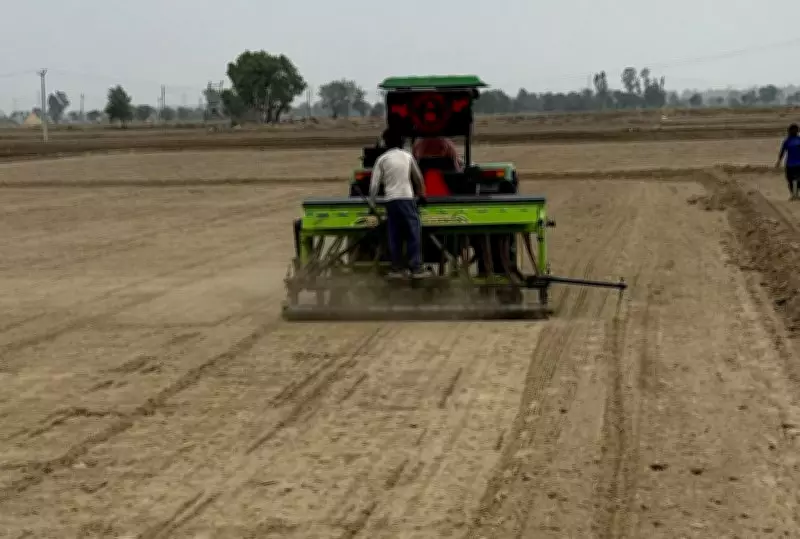
The Haryana Agriculture and Farmers’ Welfare Department has set ambitious targets for paddy cultivation in Sonepat and Panipat districts for the kharif season 2026, with paddy emerging as the dominant crop. Sonepat has been assigned a target of 3.40 lakh acres, while Panipat’s target stands at 1.82 lakh acres. Agricultural activities have accelerated as the sowing season progresses.
DSR Technique and Crop Diversification Targets
To address the growing area under paddy and its impact on groundwater, the department has increased targets for the direct seeding of rice (DSR) technique and crop diversification under the state’s flagship Mera Pani Meri Virasat (MPMV) scheme. Under DSR, Sonepat aims to cover 20,000 acres and Panipat 30,000 acres. Additionally, the department plans to diversify one lakh acres across Haryana from paddy to pulses, oilseeds, and cotton, with Sonepat assigned 2,600 acres and Panipat 3,500 acres under MPMV.
Sonepat’s Cultivation Landscape
Virender Arya, Deputy Director Agriculture (DDA), Sonepat, reported that the district has approximately 4.02 lakh acres of cultivated land, of which nearly 3.40 lakh acres are under paddy. Other crops include sugarcane on about 25,000 acres, millet on nearly 10,000 acres, fodder on about 4,000 acres, and cotton on around 2,000 acres. Arya noted that cotton cultivation once spanned nearly 50,000 acres but declined over the past 12–15 years due to pink bollworm attacks and wilt disease causing heavy losses. The department has launched an awareness campaign, visiting around 80 villages in the past month to promote the MPMV scheme and water conservation.

Panipat’s Progress and Farmer Adoption
Devender Kuhar, Sub-Divisional Officer (SDO) for Panipat and Karnal, observed that farmers are increasingly aware of climate change and the potential for a weaker monsoon due to El Nino, leading more to adopt DSR this year. Balwant Singh, DDA, Panipat, stated that paddy was cultivated on 1,84,500 acres during kharif 2025-26, with the current target set at 1.82 lakh acres. Sugarcane cultivation increased from 28,500 acres last year to a target of 29,000 acres this season. Notably, DSR adoption surged from 1,731 acres last year to around 6,000 acres already this season, while crop diversification under MPMV expanded from 564 acres to about 1,200 acres.
Farmers’ Perspectives on DSR
Ravinder Rathi, a farmer from Urlana Khurd village in Panipat, has used DSR since 2020 and sowed paddy on about 95 acres this season. He stated, “It helps save water, reduces cultivation costs, lowers dependence on labour and also provides good-quality yields.” Another farmer, Amrit Pal Singh, adopted DSR in 2024 and cultivates around 35 acres using the method. He highlighted that labourers charge nearly Rs 5,000 per acre during transplanting, but DSR significantly reduces labour needs, and the government offers a subsidy of Rs 4,500 per acre. Singh added that DSR saves time, reduces crop diseases, improves yield quality, and minimizes field humidity due to lower water requirements.