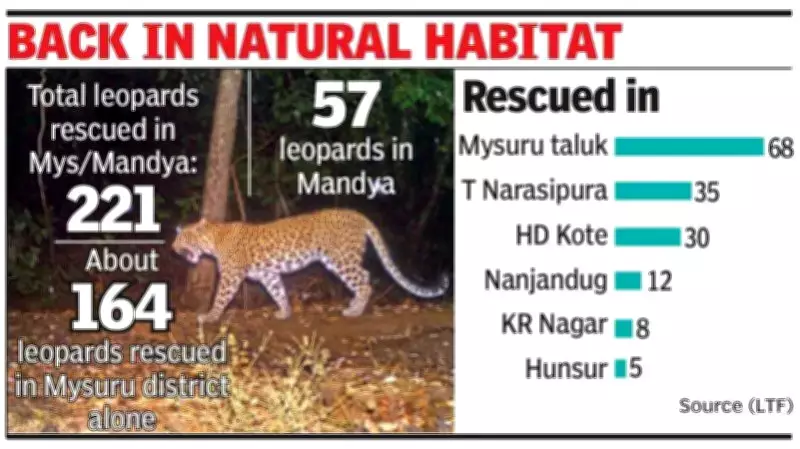
In just over three years, wildlife officials in Mysuru and Mandya districts have rescued 221 leopards, with the latest rescue occurring in Melukote, Mandya, on April 30. Remarkably, forest officials have successfully rehabilitated more than 90% of these rescued big cats.
Rescue and Release Strategy
About half of the rescued leopards were immediately released into nearby forest areas after being deemed fit to survive on their own. Before release, officials notch their ears and insert microchips for easy identification in case the animal comes into conflict with humans again. Forest officials claim this effort reflects a major achievement in leopard conservation, especially in a landscape where the wild leopard population is estimated at around 1,800 in Karnataka. The Mysuru rescue and release record is now being seen as a hopeful model for protecting endangered wildlife through active intervention, treatment, and habitat-based recovery efforts.
Leopard Task Force Formation
Since February 2023, when the Karnataka government formed the state's first Leopard Task Force (LTF), a total of 221 leopards have been rescued in Mysuru and Mandya districts. The specialized rescue unit was created after back-to-back human deaths caused by leopard attacks in T Narasipura in late 2022 and early 2023, prompting the forest department to strengthen rapid response and wildlife conflict management in the region. Of the total rescues, Mysuru district accounted for 164 leopards. Within Mysuru district, Mysuru taluk reported the highest number, with 68 leopard rescues, followed by T Narasipura with 35 and HD Kote with 30. These figures reflect the scale of human-wildlife interaction in areas located close to forest fringes, agricultural lands, and expanding settlements.

Release and Rehabilitation Success
DCF IB Prabhugouda, who heads the LTF, informed TOI that nearly 90% of the rescued leopards were released back into the wild after following standard procedures such as ear notching and microchipping. These measures help authorities identify the animals in future and monitor repeat movement or conflict patterns. The release of most rescued leopards into forest areas indicates that many were healthy enough to return to their natural habitat after capture and examination. Only about 5% were injured and died, while another 5% are currently housed in rehabilitation centers, as they were rescued when they were cubs and cannot be released into the wild. Rehabilitation is considered necessary in cases where leopards are too weak, too young, or medically unfit for relocation.
Notable Rescue Cases
Among the notable rescue cases was a recent incident in Siddhartha Nagar in Mysuru, where a leopard entered a house and was later found sleeping under a cot. Fortunately, none of the family members were harmed. Forest personnel who examined the situation said the animal may have been in shock, which possibly explained its unusual behavior and lack of aggression. Even this leopard was released. Additionally, territorial forest officials have also rescued a few leopards and released them into the woods.