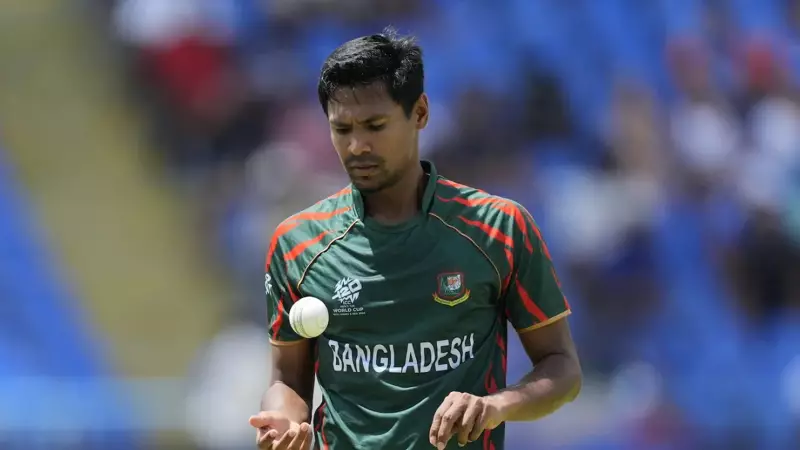
The calm exterior of Bangladesh's premier fast bowler, Mustafizur Rahman, belies the tempest currently swirling around his career. Known for his mild manners and tranquil face, the cricketer who rarely courted controversy now finds himself at the centre of a political maelstrom that has resulted in his exclusion from the Indian Premier League (IPL) next summer. This development marks a stark turn for a player celebrated as a national poster boy and a darling of the press.
From Tetulia's Streets to Global Stardom
Mustafizur's story begins in Tetulia, Satkhira district, a southwestern Bangladeshi enclave nestled between West Bengal's North 24 Parganas and Bangladesh's Khulna. Had the Radcliffe Line been drawn slightly differently, he might have played for India. The youngest of six siblings, his first sporting love was football, but he followed his brothers to play cricket with a tennis ball on local streets.
His initial dream was to emulate his idol, Pakistan's Shahid Afridi, and become a hard-hitting batsman. "I wanted to hit the ball long and clean," he once told the Dhaka Tribune, admitting he turned out to be a more defensive player. Ironically, Afridi became his first international wicket—a caught behind he later shyly confessed the batsman didn't edge.
The transformation from aspiring batsman to world-class seamer is shrouded in local lore. Some say he impressed a local batsman by casually turning his arm over. Others credit coaches at the Satkhira academy, who repurposed the 5'11" teenager into a bowler. District coach Muffachinul Islam recalled discovering a raw talent: "He had never bowled with a leather ball, did not wear spikes and had a jerky action." But he possessed a unique gift—exceptionally nimble wrists capable of a 90-degree snap at release, a foundation for his legendary cutter.
The Birth of the 'Fizz' and IPL Glory
His signature weapon, the deceptive off-cutter, was born out of a youthful bluff during an U-19 camp in Dhaka. When wicketkeeper-batsman Anamul Haque asked for a slower ball, Mustafizur, who didn't have one, nodded yes. "I rolled my fingers across and to my surprise, the ball bounced and turned, like an off-spinner," he said. Getting Haque out repeatedly confirmed he had found his strength.
This skill made him a nightmare for elite batsmen, from Rohit Sharma and Virat Kohli to Suryakumar Yadav and Jos Buttler. His bowling, smooth like Chaminda Vaas rather than his favourite Mohammed Amir, lulls batsmen before the ball jumps and stops, testing the elasticity of their reflexes.
His T20I debut was quickly followed by IPL fame. In 2016, Sunrisers Hyderabad signed him for Rs 1.40 crore. His value skyrocketed, and nearly a decade later, Kolkata Knight Riders acquired him for Rs 9.20 crore, a testament to his enduring class despite injuries. His stats are formidable: 405 T20 wickets at an economy of 7.43, Bangladesh's highest T20I wicket-taker (177), and fourth-highest in ODIs (158). His global T20 exploits across the IPL, PSL, BBL, and T20 Blast have built an estimated net worth of two million dollars.
The Unlikely Figure in a Political Storm
Contrasting with the volatile personas of some teammates, Mustafizur built a reputation as a controversy-averse, gentle giant. Even when confronted by MS Dhoni during an ODI in Mirpur, he simply avoided the veteran's gaze and walked back to his mark. He was the player the volatile Bangladeshi press adored, even following him to cover IPL games.
Yet, this very image makes his current predicament striking. The decision to keep him out of the IPL was taken at the top level of the BCCI, entangled in political tensions beyond the boundary rope. For a man whose career has been defined by quiet precision on the field, the noise of off-field politics now dictates his immediate future, sidelining a genuine match-winner at the peak of his commercial and cricketing appeal.
As the dust settles on this unexpected turn, Mustafizur Rahman's journey remains a compelling tale of humble origins, rare talent, and the unpredictable intersection of sport and geopolitics. His story underscores how an athlete's destiny can be shaped as much by lines on a map as by the lines they bowl on the pitch.