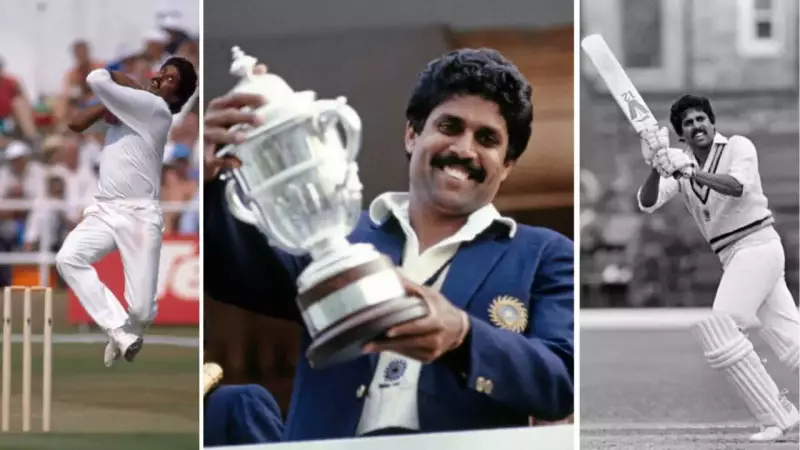
January 6 holds a unique significance in the annals of cricket history. For Australia, it marks the farewell of legends like Steve Waugh and the iconic trio of Greg Chappell, Dennis Lillee, and Rod Marsh. For India, however, this date carries a profoundly different emotional weight. It was on January 6, 1959, that Kapil Dev was born, a day that gifted Indian cricket its most unparalleled and complete match-winner.
The Unmatched Numbers of a True All-Rounder
Kapil Dev's statistical legacy remains untouched in Indian cricket. He is still the only Indian to achieve the monumental double of 4,000 runs and 400 wickets in Test cricket. His final tally reads 5,248 runs with eight centuries and 434 wickets—a world record at the time of his retirement, surpassing New Zealand's Richard Hadlee. His career spanned 131 Tests, a testament to remarkable durability for a fast bowler of his era. Notably, he was on the verge of playing 132 consecutive Tests, missing just one in 1984-85 due to a disciplinary measure.
In One-Day Internationals, his singular status continues. Kapil Dev is the only Indian to score over 2,500 runs and take more than 250 wickets, finishing with 3,783 runs and 253 scalps. These staggering numbers were compiled while he shouldered the captaincy and led India to its epoch-making first World Cup triumph in 1983.

Beyond Numbers: The Heart of a Champion
Kapil Dev's greatness wasn't defined by sheer pace or mystery. Compared to his celebrated contemporaries—Imran Khan, Ian Botham, and Richard Hadlee—his strike rate was less dominant. His genius lay in relentless accuracy, tireless stamina, and the potent ability to swing the ball away from right-handers. He bowled long, demanding spells across all conditions without complaint.
With the bat, he was fearless and instinctive. His Test career is dotted with innings that shaped India's fortunes. His 129 out of a total of 221 against South Africa in Port Elizabeth, where the rest of the team managed just 86, is the stuff of legend. His all-round mastery was on full display in Madras (now Chennai) in 1980 against Pakistan, where a blistering 84 and 11 wickets sealed a series victory. In the 1981-82 series against a powerful England side, he amassed 318 runs and took 22 wickets.
Even in the twilight of his career, during the 1991-92 tour of Australia, he claimed 25 wickets. His consistency was global: he averaged over 40 with the bat against England and 25 with the ball against Australia.
The Iconic Moments That Defined an Era
Some moments transcend statistics. At Lord's in 1990, with India needing 23 to avoid the follow-on against England's off-spinner Eddie Hemmings, Kapil Dev launched an audacious assault. He smashed four consecutive sixes, becoming the first player in Test history to achieve this feat—a record only three have matched since.
However, no moment is more central to his legend than the 1983 World Cup. A young captain of just 24, leading a team with minimal expectations, Kapil Dev faced a crisis against Zimbabwe at Tunbridge Wells. With India reeling at 17 for 5, he played one of the greatest ODI innings ever: an unbeaten 175 from 138 balls. This wasn't just a rescue act; it was the catalyst that galvanized a team and a nation, setting them on the path to an impossible World Cup victory.
A Legacy That Still Stands Alone
As noted in a compelling social media analysis by journalist Abhishek Mukherjee, while every other Indian great's resume has a notable absence—a missing World Cup, a specific series win, or a particular record—Kapil Dev's checklist remains complete. He did it all. He captained India to a World Cup, held the world record for Test wickets, and delivered monumental performances with both bat and ball across formats and continents.
His career is not a story of a single trophy or innings. It is the story of relentless accumulation—of runs, wickets, victories, and responsibilities. On January 6, Indian cricket doesn't merely celebrate a birthday. It commemorates the arrival of its most irreplaceable cricketer, a giant whose all-round void has yet to be filled decades after his retirement.