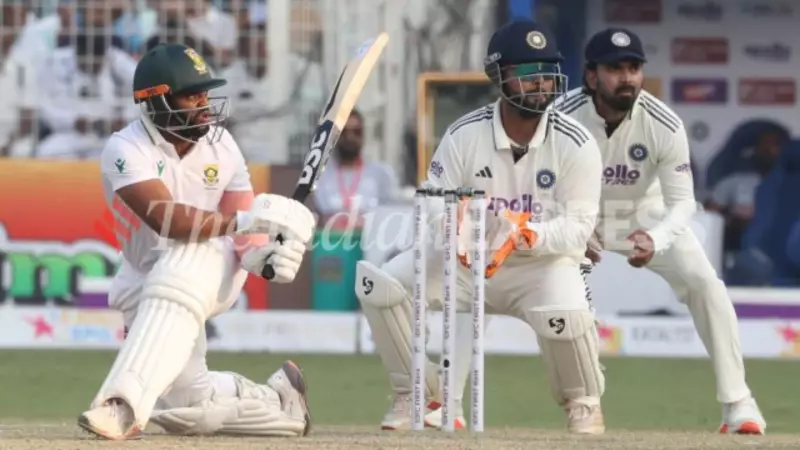
Former Indian cricket legend Sunil Gavaskar has dissected the batting technique of South African captain Temba Bavuma, praising his innings as a masterclass in traditional Test match play. This analysis comes after the first Test between India and South Africa in Kolkata, which concluded within three days on a challenging pitch.
Bavuma's Lone Stand on a Tough Pitch
The first Test at Kolkata's iconic venue saw batters from both teams struggle significantly. No batter managed to score more than 50 runs except for South Africa's captain, Temba Bavuma. The wicket was unpredictable, with inconsistent bounce and the occasional ball turning sharply. Despite these adverse conditions, Bavuma displayed immense patience, solid temperament, and a refined technique.
His unbeaten 55 runs came from 136 deliveries, a slow but crucial knock that helped South Africa post a second-innings total of 153. This, combined with India's first-innings lead of 30 runs, set a target of 124 for the home team to win. However, India fell short, making Bavuma's resilient innings the standout performance in a low-scoring match.

Gavaskar's Technical Breakdown
In his column for Sportstar, Sunil Gavaskar provided an in-depth technical analysis of what made Bavuma so effective where others failed. Gavaskar highlighted two key elements: a short back-lift and soft hands.
He explained that Bavuma's compact back-lift and the way he held the bat with soft hands allowed him to control his bat speed perfectly. This technique ensured that even if the ball took the edge of the bat, it would not carry at a dangerous pace to the close-in fielders, a common mode of dismissal on such surfaces.
"He also showed admirable patience and great temperament, even when the ball went past the outside edge," Gavaskar wrote. He concluded by emphatically stating that Bavuma's approach was the essence of "proper Test match batting" and stood in stark contrast to the methods of modern batters who struggle when the pitch is not flat and the ball is moving.
The Pitch Debate and Gavaskar's Defense
The rapid conclusion of the Test match, with 15 wickets falling on the second day alone, sparked widespread debate about the quality of the playing surface. Many questioned if the pitch was suitable for a fair contest between bat and ball.
However, Gavaskar strongly defended the Kolkata pitch in an interview with India Today. He drew comparisons with other international venues to counter the criticism. He pointed out that 17 wickets fell on the first day of a Test match in Perth during India's tour of Australia. He further listed other instances:
- Adelaide: 11 wickets on day one, 14 on day two.
- Sydney: 11 wickets on day one, 15 on day two.
- Leeds: 10 wickets on day two.
Gavaskar expressed his frustration at what he perceives as a double standard, noting that while pitches in countries like Australia and England often see similar clusters of wickets, they rarely face the same level of sarcasm and criticism that is frequently directed at pitches in the Indian subcontinent.