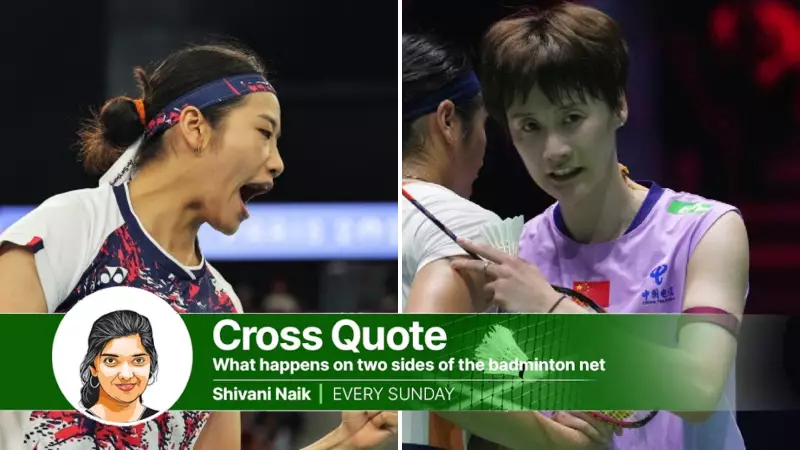
In the relentless world of international badminton, one rivalry has come to define the current era: the gripping, dead-even contest between South Korea's An Se-young and China's Chen Yufei. As of January 2026, their head-to-head record stands at a perfectly poised 14-14 after 28 encounters that began back in 2018. This statistical marvel underscores not just their individual brilliance but highlights a central mission for Chinese badminton: decoding and defeating the seemingly unbeatable An Se-young.
A Rivalry Forged in Fire
The An Se-young versus Chen Yufei saga is a testament to consistency in a crowded tour. Despite a recent injury to Chen Yufei preventing another chapter at the Malaysia Open, their frequent meetings have created a narrative as vivid and unmissable as a neon vest in fog. The quality of their matches remains undiminished by quantity, ranging from swift straight-set victories to epic three-game battles, always contingent on their fitness levels on the day.
What makes this duel fascinating is the ebb and flow of dominance. Chen Yufei won their first seven meetings. However, in a stunning reversal of fortunes, An Se-young has claimed 10 of their last 14 clashes. This shift coincided with An's meteoric rise, where her prime intersected with the declining curves of legends like Carolina Marin, Nozomi Okuhara, Akane Yamaguchi, Tai Tzu-ying, and even India's PV Sindhu. It leaves fans wondering if those greats, at their peak, could have withstood An's relentless assault.

The Chinese Conundrum: A System Under Threat
The Chinese badminton machinery, built for sustained global dominance, views An Se-young as its primary obstacle. While other nations struggle to find answers, Chinese shuttlers, particularly Chen Yufei and He Bingjiao, have had relative, albeit limited, success. The focus is intensely inward, analyzing their own games to find a solution, as identifying weaknesses in the Korean's near-flawless play is a challenge itself.
Chen Yufei's approach is revealing. Speaking to the Badminton World Federation (BWF), she emphasized that consistency, not perfection, is the potential key. "On a scale of 10 for maximum performance, if I can play at level eight or nine I’d stand a chance. Anything less than I’d lose," Yufei stated, adding a layer of poised realism to the daunting task. The strategy employed by her and He Bingjiao involves a relentlessly technical style, constant game-plan switches, and on-the-feet thinking—a department where Yufei excels.
Why Other Contenders Fall Short
The contrast with other top players is stark. PV Sindhu, despite promising displays like her recent push against Wang Zhiyi in the Malaysia Open semifinal, has not come close to defeating An Se-young in eight attempts. Tai Tzu-ying found her deceptive genius neutralized by the Korean's preternatural reading of the game and swift footwork. An's ability to absorb deception and maintain rhythm forces opponents into a grueling battle of sustained high-level play.
This is where Chen Yufei's insight is crucial. She suggests that a sustained 9/10 performance over three sets is more effective than a brilliant 10/10 in two sets followed by a drained 5/10 in the decider—a fate that has befallen others. For China's hopefuls like Wang Zhiyi, who has lost 7 of her 8 finals to An Se-young, the path forward is clear but steep. The 2026 season is shaping up to be a definitive chapter in the ongoing saga of China versus An Se-young, with Chen Yufei holding the most cryptic clues to unlocking this puzzle.