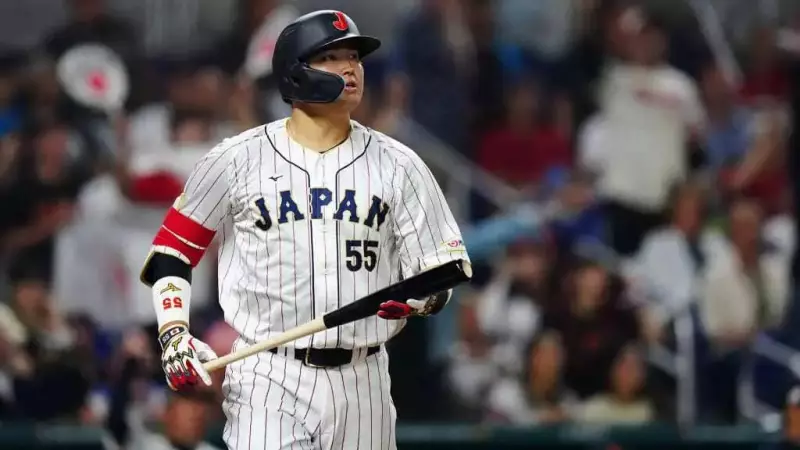
The free agency journey of Japanese baseball sensation Munetaka Murakami is defying expectations. Unlike most star hitters who generate immediate buzz and a clear list of suitors, Murakami's market is characterised by a puzzling silence and a distinct lack of urgency. Front offices across Major League Baseball are observing from afar, analysing the same set of impressive yet concerning statistics, and reaching vastly different conclusions about his future.
The Power vs. Strikeout Conundrum
There is no debate about Munetaka Murakami's raw talent. For years in Japan's Nippon Professional Baseball (NPB), he has established himself as a feared power hitter, routinely launching 30 home runs and mercilessly punishing pitchers' mistakes. Scouts universally agree that his raw strength ranks among the very best to ever emerge from Japan, a trait that should, in theory, translate seamlessly to the major leagues.
However, the hesitation stems from a significant flaw in his otherwise formidable profile. From the 2023 season through 2025, Murakami struck out in approximately 28 to 29 percent of his plate appearances. This is an unusually high rate for the contact-oriented NPB. Even by MLB's more strikeout-tolerant standards, this places him in a risk category that teams approach with extreme caution. The central question for franchises is clear: does his game-changing power outweigh the considerable swing-and-miss tendency that comes with it? This fundamental uncertainty has effectively put the brakes on his free agency, making it one of the most difficult markets to predict this offseason.
Insider Perspective: A Market Shrouded in Mystery
MLB insider Ken Rosenthal has shed light on the quiet nature of Murakami's free agency. "He's the biggest mystery on the market because we don't hear, or haven't heard, many teams involved," Rosenthal stated. He clarified that a lack of public noise doesn't necessarily mean a lack of interest, as negotiations with Japanese players often occur discreetly. Rosenthal also noted similar quiet surrounds other Japanese players like Okamoto and Imai.
Rosenthal addressed the inevitable comparisons to other Japanese hitters, particularly Shohei Ohtani, when discussing strikeout concerns. He pointed out that Ohtani's strikeout rate in Japan from ages 18 to 22 was even higher than Murakami's career rate. Conversely, he highlighted Seiya Suzuki, who succeeded in MLB after posting a much lower strikeout rate in Japan. This contrast frames Murakami as a classic "boom-or-bust" prospect in the eyes of evaluators, further explaining the industry's cautious pause.
The Stalemate and What Comes Next
The current impasse boils down to a split in team evaluations. One camp views Murakami as a potential middle-of-the-order powerhouse who can anchor a lineup. The opposing camp sees a hitter whose profile might struggle to adapt against the elite velocity and breaking pitches of Major League pitching. This division has created a stalemate.
Until one perspective gains enough traction to spark a serious offer or a team decides to take a calculated gamble on his transcendent power, Munetaka Murakami's free agency is likely to remain in its current state: quiet, cautious, and under the intense but distant watch of every MLB front office. The resolution will serve as a telling indicator of how modern teams value pure power when it is packaged with significant risk.