Vishy Anand's Unretired Spirit: Why the Chess Legend Still Competes
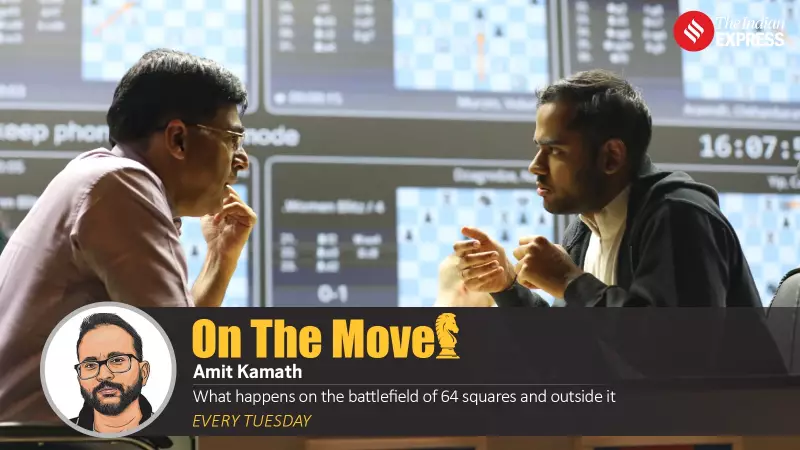
Five-time world chess champion Viswanathan Anand never fell into the retirement trap. He only plays occasionally now, but finds it increasingly difficult to watch from the sidelines as his competitive urge rears its head.
The Voice That Changed Everything
Sometime last year, while serving as an ambassador at the Tata Steel Chess Tournament, Anand heard a persistent voice in his mind. For at least five years before that moment, he had been weaning himself off competitive chess. He played just a couple of events annually and described himself as a semi-retired player.
Anand filled the void with other roles. He serves as deputy president of the global chess federation FIDE. He occasionally provides analysis on the official FIDE YouTube stream for major events like World Championships and World Cups. Through his Westbridge Anand Chess Academy, he mentors rising stars including reigning world champion D Gukesh and R Praggnanandhaa.

But last year, that internal voice declared he had enough of sitting on the sidelines. The athlete's itch to compete took over completely.
The Breaking Point in Kolkata
"At the end of last year in Kolkata, I had the feeling that I'd hit my limit just coming to watch the tournament," Anand told his contemporary Dibyendu Barua during a press conference at the recent Tata Steel India Rapid and Blitz tournament. "It is much harder than playing. I got fed up with not playing."
He explained the gradual shift in perspective. "You come to a tournament and the first year, you enjoy it. It's fun watching and leaving. The following year, you do it again. But last year, I thought, 'How many years can I just stand there and watch?'"
Nagged by this question, Anand accepted the invitation to play in Kolkata. By strange coincidence, another invitation appeared unexpectedly for a tournament in Jerusalem.
Muscle Memory and Mental Challenges
Having played at the top level for decades, Anand's mental muscle memory for finding good moves remains intact. "It's not that my moves would be totally off. I know what the young chess players are doing these days," he said regarding opening ideas.
However, extended breaks present different challenges. "After seven or eight months of not playing chess, when you're actually playing, the thought of 'What am I actually going to do now? What opening am I going to play?'... all these decisions, you forget how to think about that after a long break," Anand admitted.
The Six-Month Question
This internal monologue recalls a different conversation twenty-one years ago. At the Linares tournament, Garry Kasparov stunned the world by announcing his retirement at age forty-one immediately after winning the event.
During the closing ceremony, Anand questioned Kasparov. "Don't you think that six months from now, you will be sorry? That you will be lost without playing?" he asked.
"Ask me in six months," Kasparov responded.
Kasparov never reversed his retirement decision. Instead, he stayed connected to chess through multiple books while becoming a public speaker and democracy activist in Russia. Anand, perhaps wondering if he would regret retirement in six months, never cut the cord completely.
The Treacherous Nature of Athletic Retirement
Athlete retirements prove treacherous transitions. About a decade ago, ESPN's Wright Thompson spent considerable time with Michael Jordan as the basketball legend turned fifty. Jordan had retired a decade earlier and become a billionaire through sponsorships.
Thompson recognized Jordan still ached to play. He would watch NBA games on television and mentally compete against current stars. He would step on the weighing scale and think about two hundred eighteen pounds, his playing weight.
"There's a palpable simmering whenever you're around Jordan, as if Air Jordan is still in there, churning, trying to escape," Thompson wrote. "It must be strange to be locked in combat with the ghost of your former self."

During those interviews, Jordan revealed he always thought he would die young. Thompson later rationalized Jordan "just could never imagine being old. He seemed too powerful, too young, and death was more likely than a slow decline."
When Athletes Call Time
In some sports, particularly team games, coaches or management sometimes make retirement decisions for athletes. In other cases, the body or mind signals it's time.
This happened with Australian cricket captain Alyssa Healy, who retired admitting "The last few years have been probably more mentally draining than anything else due to injuries. You got to dive into the well a couple of times and probably that well was getting less and less full of water, so it was getting harder to dive back in there."
At a subsequent press conference, Healy explained further: "I've somewhat lost that competitive edge that's kept me driven since the start."
The Madras Tiger's Unchanging Stripes
As demonstrated at the Tata Steel Chess tournament, Anand can still summon that competitive edge whenever necessary. The mental agility remains sharp despite reduced playing time.
His journey reflects a fundamental truth about elite competitors. The drive to test oneself against the best never fully disappears, even when formal retirement seems logical. For Anand, watching from the sidelines became more challenging than facing opponents across the board.
The chess legend continues navigating that delicate balance between stepping back and stepping up. He proves some champions never truly leave the arena, even when they occasionally watch from its edges.