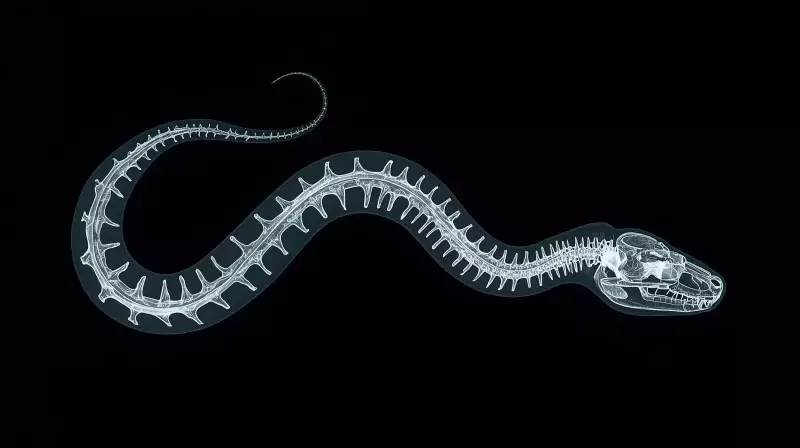
Imagine reading a scientific paper title that makes you pause: 'Right-handed snakes.' The concept seems almost absurd. Snakes don't write or throw. Yet, a fascinating 2007 study reveals that in the silent, sliding world of these reptiles, a profound form of 'handedness' or asymmetry has evolved, driven by a dietary specialization that is as precise as a key fitting a lock.
The Functional Specialisation in a Snake's Skull
The research, titled 'Right-handed snakes: convergent evolution of asymmetry for functional specialisation' and available on PubMed Central, focused on Iwasaki's snail-eater. When scientists examined its skull under X-ray, they found a clear, though subtle, imbalance. The right side of the snake's jaw consistently had more teeth than the left side. This wasn't a random flaw but a functional adaptation.
These snakes don't crush the shells of their prey. Instead, they patiently work their specialized jaws into the opening of a snail's shell to extract the soft body inside. The extra teeth on the right side provide a superior grip and finer control during this delicate operation. It's not about brute force; it's about perfect fit. The snake uses what works, and over countless generations, this repeated use subtly reshapes its very bone structure. There is no conscious plan, only the relentless pressure of efficiency.

Why Most Snails Set the Evolutionary Rule
The driving force behind this asymmetry is the prey itself. The vast majority of snail species coil their shells to the right. This 'right-handed' coiling is simply how their bodies develop. For a snail-eating snake, the common right-coiled shell becomes the standard landscape it must navigate. The angle of attack, the points of resistance, and the internal path are all learned and optimized for this predominant form. Predators adapt to the common, not the exceptional.
To test this theory, researchers observed four snakes feeding. The results were striking. When offered right-coiled snails, the snakes were swift and efficient, requiring fewer jaw movements. However, left-coiled snails presented a significant challenge. The snakes hesitated, their tried-and-tested method faltered. Some left-coiled snails even managed to escape the encounter entirely, surviving in the lab for a week after the failed predation attempt. The predator was not incompetent; its anatomy was simply fine-tuned to a different world.
The Survival Edge of Being Different
This evolutionary arms race has a fascinating twist. The very rarity that makes left-coiled snails unusual also grants them a survival advantage against predators shaped by the right-coiled majority. The study found that these 'left-handed' snails escaped more often. Separate research indicates they survive crab attacks at higher rates as well.
However, nature rarely offers free lunches. This defensive benefit can come at a cost to reproduction, as famously illustrated by Jeremy, the left-coiled snail who struggled to find a compatible mate. Survival and reproduction can pull in opposite directions, and evolution leaves these tensions unresolved, operating as quiet, background forces that shape the diversity of life. The story of the right-handed snake and its snail prey is a powerful reminder of how specific ecological relationships can write their rules directly into an animal's skeleton.