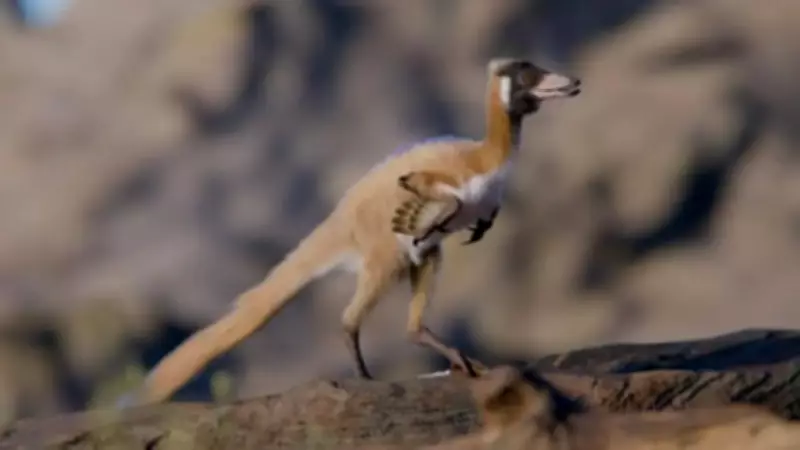
When the word 'dinosaur' comes to mind, images of towering giants like the T. rex or Brachiosaurus often dominate. However, not all dinosaurs were colossal. A recent discovery in Argentina has unveiled a near-complete fossil of one of the world's smallest dinosaurs, challenging the perception that the Cretaceous period was solely an age of giants. The newly identified species, Alnashetri cerropoliciensis, was roughly the size of a crow, measuring about 28 inches (70 cm) in length, most of which was its tail.
Discovery in Patagonia
The fossil was unearthed at a site called La Buitrera in northern Patagonia's Rio Negro Province, an area known for preserving fossils from the Cretaceous Period. Approximately 95 million years ago, this region was dominated by massive dinosaurs such as Giganotosaurus (weighing about eight tonnes) and Argentinosaurus (weighing about 70 tonnes). Yet, this tiny dinosaur coexisted with these giants, highlighting the ecosystem's diversity. The researchers named the specimen Alnashetri cerropoliciensis, nicknamed 'Alna'.
Physical Characteristics and Behavior
According to the study published in the journal Nature, Alna was a small female that lived in a desert environment and died at around four years of age, nearly fully grown. Its body was quickly covered by a sand dune after death, leading to exceptional preservation. The dinosaur weighed approximately 0.7 kg (1.5 pounds), smaller than a chicken, and would not reach knee height on an average adult. It had a thin, fragile skeleton, numerous strong, pointy teeth similar to a small Velociraptor, and likely hunted small animals like lizards, snakes, mammals, and invertebrates.

Belonging to the Alvarezsauria Family
Alnashetri belongs to the Alvarezsauria family, an unusual group of theropod dinosaurs that includes all meat-eating dinosaurs. These creatures were predominantly small, with stubby but powerful forelimbs, long and slender hindlimbs, and lightly built skulls. Researchers doubt that Alna had feathers, despite some birdlike traits, as alvarezsaurs were only distantly related to birds. The team noted that its body resembled a rooster but with a long tail, and its arms were well-developed but not long enough for flight.
Life in the Kokorkom Desert
The region where Alna lived was called the Kokorkom, meaning 'desert of the bones' in the local language. While many inhabitants of this desert were burrowers, Alnashetri was a lightweight animal that moved across dunes on its slender legs. The exquisite preservation allowed researchers to study microscopic bone structures, revealing remarkable histological detail. Paleontologist Sebastián Apesteguía of the Felix de Azara Foundation and CONICET in Argentina stated, 'The level of histological detail is exquisite.'
Implications for Biodiversity
This discovery underscores that the Cretaceous period was not solely an age of giants but a time of immense biodiversity. Apart from birds, which evolved from small feathered dinosaurs, Alnashetri is the smallest dinosaur known from South America and among the tiniest ever discovered worldwide. As Apesteguía noted, 'When we think of landscapes with dinosaurs, or through the lens of film fiction, we picture vast expanses with enormous beasts roaming in the distance. But these landscapes are almost always devoid of a crucial component of the ecosystem: medium and small animals. Alnashetri shows us that it wasn't a time of giants, but rather a time of immense biodiversity.'