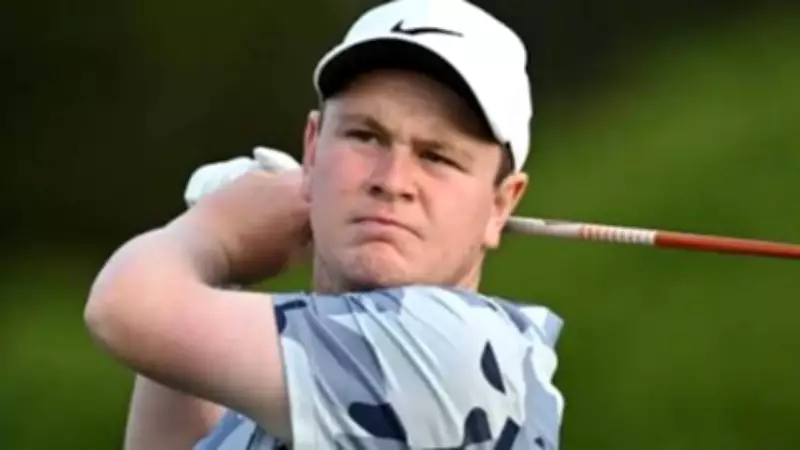
Robert MacIntyre's Masters Debut Derailed by Anger and Quadruple Bogey
The opening round of the Masters Tournament at Augusta National proved to be a harsh introduction for world No. 8 Robert MacIntyre. What began as a promising start quickly spiraled into a day of frustration and poor performance, culminating in a score of eight-over par 80 that left him languishing near the bottom of the leaderboard.
A Promising Start That Quickly Unraveled
MacIntyre initially showed composure, navigating the challenging Augusta course to go one under par through the first four holes. However, his game deteriorated dramatically over the subsequent 14 holes, where he dropped nine shots through a combination of three bogeys, one double bogey, and most damagingly, a quadruple bogey nine on the par-5 15th hole.
By the conclusion of his round, MacIntyre found himself tied for 82nd position, a staggering 13 shots behind co-leaders Rory McIlroy and Sam Burns. The Scottish golfer's struggles were particularly noticeable at a venue where discipline and course management are as crucial as raw skill.

Visible Frustration Captured on Camera
What compounded MacIntyre's scoring difficulties was his visible emotional reaction to the deteriorating situation. Television cameras captured multiple instances where the golfer's frustration boiled over. On the treacherous 15th hole, after hitting two consecutive shots into the water hazard, MacIntyre was seen raising his middle finger in the direction where his ball had disappeared.
Earlier in his round, on the iconic par-3 12th hole, microphones picked up MacIntyre uttering "Jesus, f***" following a poorly executed shot. These reactions have generated significant discussion within the golf community, particularly given Augusta National's longstanding reputation for decorum and its expectation that players maintain composure regardless of circumstances.
Historical Context of Emotional Masters Moments
MacIntyre's visible frustration places him within a broader historical context of emotional displays at the Masters Tournament. Augusta National's emphasis on tradition and respectful conduct has created an environment where emotional outbursts stand out prominently.
Recent years have witnessed several notable incidents:
- In 2021, Billy Horschel was captured on camera repeatedly striking his golf bag after a poor shot, later issuing an apology for his behavior.
- Tyrrell Hatton openly criticized his own performance during the 2022 tournament, describing it as "disgusting" in post-round comments.
- Current world No. 1 Jon Rahm displayed visible frustration last year when he slammed his club into the ground during a challenging round.
- Even five-time Masters champion Tiger Woods has experienced moments where emotions overcame discipline, most notably in 2012 when he was seen kicking his club during a difficult stretch.
The tournament has also witnessed unusual behavioral incidents, such as amateur Jose Luis Ballester's decision to run into Rae's Creek during his round last year, though officials permitted him to continue playing.
The Path Forward for MacIntyre
With multiple rounds remaining in the tournament, attention now shifts to how MacIntyre will respond to this challenging debut. The golfer faces the dual challenge of improving his technical performance while managing the psychological impact of his first-round struggles and the subsequent scrutiny of his emotional reactions.
Augusta National's unique pressures often separate champions from contenders, and MacIntyre's ability to demonstrate resilience in both his game and demeanor will be closely monitored by observers and officials alike. His experience serves as a reminder of the Masters Tournament's unique ability to test golfers not just technically, but emotionally and psychologically as well.