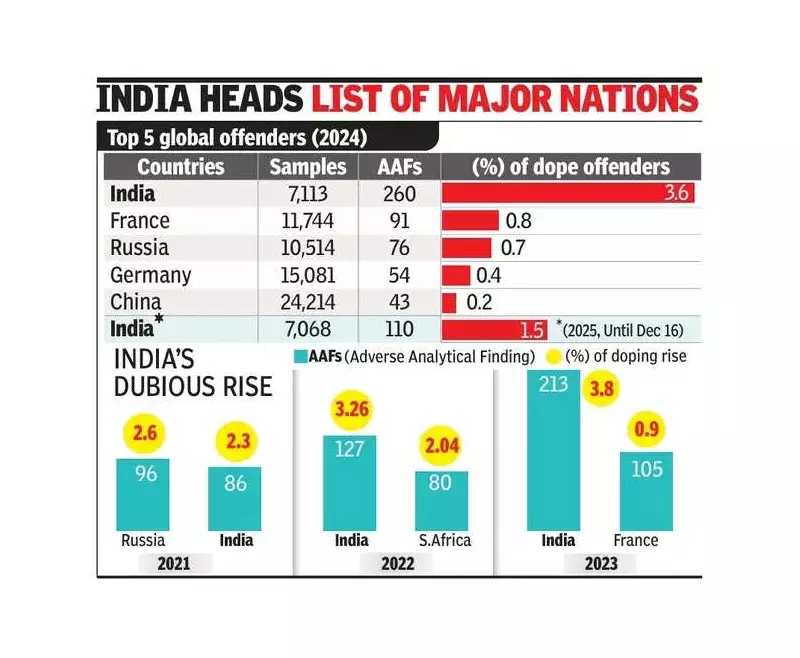
India has once again been identified as the world's worst offender in doping violations, securing the top rank for an unenviable third consecutive year. The latest report from the World Anti-Doping Agency (Wada), published on its website late Tuesday, reveals that Indian athletes were involved in a record 260 dope-related activities in 2024.
A Record High Amidst Major Sporting Ambitions
This alarming finding comes at a critical juncture for Indian sports. The nation is deep in preparations to host the centenary edition of the Commonwealth Games in 2030 and is aggressively pursuing a bid to host the prestigious 2036 Olympic and Paralympic Games. The timing is particularly sensitive as the International Olympic Committee (IOC) had previously raised red flags over rampant doping during a visit by an Indian delegation to its Lausanne headquarters in July to assess the feasibility of an Olympic bid.
The Wada data shows India accounted for 260 adverse analytical findings (AAFs), which translates to a positivity rate of 3.6 percent. This is the highest rate among all countries that conducted 5,000 or more tests globally. The National Anti-Doping Agency (NADA), headquartered in Delhi, was responsible for these tests, conducting a total of 7,113 tests in 2024. This comprised 6,576 urine samples and 537 blood samples.

Breaking Down the Numbers: Urine vs. Blood Tests
A detailed breakdown of the figures paints a clear picture of the scale of the problem. Out of the urine samples tested, 253 returned positive for prohibited substances. This includes 196 from in-competition tests and 57 from out-of-competition tests. Furthermore, seven blood samples also failed the dope test, with four being in-competition and three out-of-competition.
In its defense, NADA has insisted that the high numbers are a direct result of its more aggressive and expanded testing regime. The agency pointed out that in 2023, a total of 213 positive cases were found from 5,606 samples. However, this explanation is challenged when compared to the testing outcomes of other leading sporting nations.
How India Compares with Other Sporting Powers
The contrast with other major athletic countries is stark and underscores the depth of the issue in India:
- France tested 11,744 samples and recorded only 91 anti-doping rule violations (ADRVs), a mere 0.8% positivity rate.
- Russia, which led the doping charts until 2021, accounted for 76 ADRVs from 10,514 samples, a 0.7% rate.
- China reported just 43 dope failures from a massive 24,214 samples, resulting in a minimal positivity rate of 0.2%.
- The United States anti-doping agency conducted fewer tests than India (6,592) but had a significantly lower positivity rate of 1.1%.
The report highlights that the doping menace is deeply entrenched in Indian sporting culture. It emphasizes an urgent need for a more robust scientific and research ecosystem. A significant concern raised is the apparent lack of basic knowledge among Indian coaches, doctors, and physiotherapists attached to various sports teams regarding the use of performance-enhancing supplements and medicines.
"While this position may appear concerning at both national and international levels, it is essential to underscore that the figures are a direct outcome of India’s intensified anti-doping efforts, marked by expanded testing and stronger detection mechanisms rather than a surge in doping prevalence," NADA stated in an official communication.
There appears to be a slight improvement in the current year's preliminary data. NADA has reported that in 2025, it has so far conducted 7,068 tests, resulting in a lower positivity rate of 1.5% with 110 adverse findings.
Recognizing the severity of the crisis, the Indian Olympic Association (IOA) has recently formed a new anti-doping panel. Concurrently, the government has passed a national anti-doping bill aimed at ensuring the highest standards of integrity in sports, a crucial step for a nation with soaring athletic ambitions.