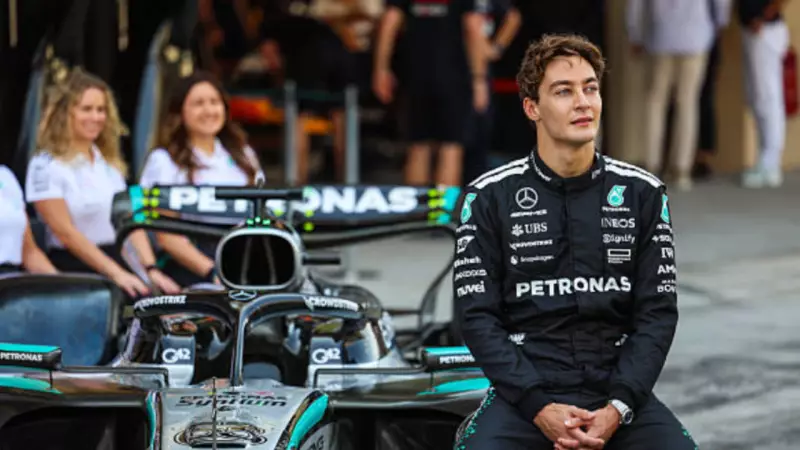
In the high-stakes world of Formula One, where every millisecond counts, a driver's physical attributes can be as crucial as their racing strategy. For Mercedes-AMG Petronas star George Russell, his notable stature presents a unique set of challenges and adaptations. Standing tall at 6 feet 1 inch (approximately 185 cm), the British driver is consistently ranked among the top three tallest competitors on the grid, alongside Alex Albon and Esteban Ocon as of 2025.
The Physical Demands of a Tall Driver in F1
Becoming a champion in Formula One requires more than just strategic brilliance; physical fitness and compatibility with the machine are paramount. For a driver like Russell, who weighs around 154 lb (70 kg), his height can initially be a disadvantage. The cockpit of a modern F1 car is a tightly packaged environment designed around aerodynamics and minimum weight. Drivers must acclimatise their bodies to fit precisely into this confined space, a task that is more complex for taller individuals.
Russell, who made his F1 debut in 2019 with Williams for the Australian Grand Prix and later joined the Mercedes works team in 2022, faced significant hurdles early in his career. Fitting his lean frame into the car's cockpit required specific adjustments. Furthermore, tall drivers must develop exceptional neck stability to withstand immense G-forces during races, a training aspect that becomes even more critical with a longer lever arm.

Adapting the Machine and the Man
The narrative around height in F1 isn't solely about limitations. The sport's engineering marvels have evolved to accommodate a wider range of physiques. Modern racing cars are built with adaptable ergonomics, allowing teams like Mercedes to tailor the cockpit's dimensions, seat placement, and pedal box to suit their driver's specific needs. This technological flexibility helps mitigate the inherent challenges Russell faces.
Interestingly, Russell has previously resorted to personal adaptations as well, including reportedly wearing racing boots smaller than his actual foot size in his early days to better fit the pedal area. Such anecdotes highlight the extreme lengths drivers go to for optimal integration with their car. The focus is always on creating a seamless driver-machine unit where the pilot's physique works in harmony with the car's aerodynamics and balance.
Height vs. Performance: The Ongoing Balance
While Russell's height is an eye-catching statistic, his performance on track demonstrates that it is a manageable factor, not a prohibitive one. His success with Mercedes underscores that with the right team support, training, and technical adaptations, physical stature can be effectively engineered around. The debate around driver height ultimately circles back to the core principle of F1: it is a sport of optimisation.
Every aspect, from car design to driver fitness, is fine-tuned for peak performance. For George Russell, being one of the tallest on the grid is a distinctive part of his profile, but it is his skill, speed, and the team's ability to adapt that truly define his race-winning potential. His journey illustrates that in contemporary Formula One, talent and technology can triumph over traditional physical constraints.