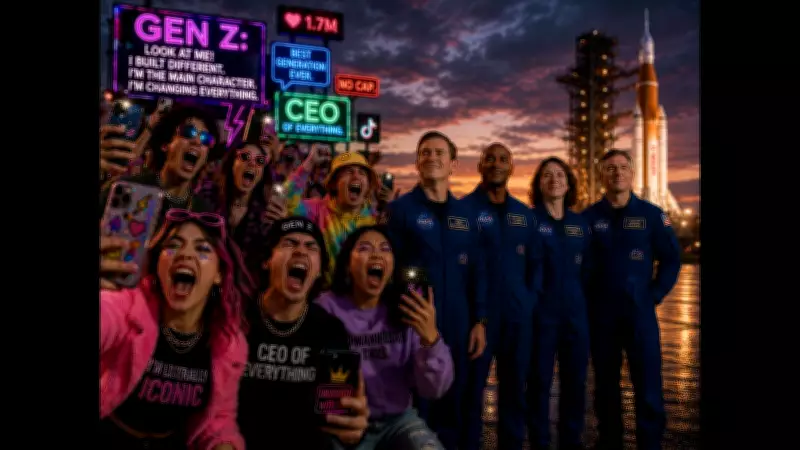
The Unseen Generation's Giant Leap
In an era dominated by social media trends and digital noise, a remarkable story of quiet achievement has emerged. While younger generations focused on online fame, four astronauts in their late 40s accomplished something truly historic: they journeyed to the far side of the Moon and returned safely. This feat, achieved by the Artemis II crew, highlights a broader narrative about Generation X—a group often overlooked but now stepping into the spotlight with unparalleled competence.
A Mission Beyond the Hype
The Artemis II mission, launched in 2026, saw astronauts Reid Wiseman (50), Victor Glover (49), Christina Koch (47), and Jeremy Hansen (50) travel an astounding 252,760 miles from Earth. This distance marks the farthest any human has ventured since 1972, breaking records and making history without the fanfare of viral moments. Their calm, unbothered demeanor during the mission captivated a world briefly pausing its endless scroll, showcasing a mastery that defies modern obsessions with visibility.
Challenging Ageism in the Digital Age
This achievement comes amid ongoing debates about ageism on social media. Recently, former Canadian Prime Minister Justin Trudeau, aged 54, faced criticism for attending the Coachella Valley Music & Arts Festival with singer Katy Perry. Comments like those from user @stephenRB4 highlighted the absurdity of such critiques, emphasizing that people of all ages should enjoy music freely. The Artemis II crew, with their ages ranging from 47 to 50, further dismantles stereotypes, proving that prime years extend far beyond youth in an internet culture that often treats 30 as an expiry date.

The Latchkey Legacy: Independence Forged Early
Generation X, born between 1965 and 1980, is frequently dubbed the "latchkey generation" due to their upbringing in an era of less parental supervision. Research indicates that this independence fostered resilience, self-sufficiency, and resourcefulness. Often described as the "Jan Brady of generations," sandwiched between vocal Boomers and Millennials, Gen Xers learned to solve problems on their own—a skill set that proved crucial for the Artemis II mission's success. Their ability to manage crises without external validation stems from childhood experiences of letting themselves into empty homes and making dinner at age 10.
Experience Over Enthusiasm: The Gen X Edge
In a world that glorifies youth and disruption, Generation X brings a different kind of innovation: one rooted in deep experience. The Artemis II crew demonstrated this during manual proximity operations, where they piloted the Orion spacecraft using only onboard cameras and judgment, without GPS assistance. This precision, honed through years of training, underscores that experience cannot be hacked or downloaded. Studies, such as one from the University of Michigan, reveal that Gen Xers are often happier and more satisfied with their jobs than popular narratives suggest, with a median happiness score of eight out of ten.
Quiet Leadership in a Noisy World
Generation X holds over one-third of the workforce and occupies most leadership roles, managing between Boomer bosses and Millennial teams. Their holistic approach to technology—remembering pre-internet days while adapting to new systems—makes them invaluable. As generational researcher Mary Donohue warns, organizations risk depleting intellectual capital if they neglect Gen X. The Artemis II mission embodied this, carrying knowledge passed down from spaceflight pioneers, held by individuals in their late 40s and early 50s.
The Gen X Ethos: Show, Don't Tell
Gen X's ethos is characterized by action over announcement. Christina Koch holds the record for the longest single spaceflight by a woman, Victor Glover is the first Black astronaut to travel to the Moon, and Jeremy Hansen is the first Canadian to leave low-Earth orbit. Yet, their achievements were marked by quiet professionalism, such as Hansen naming a lunar crater after a colleague's late wife in a private, tearful moment. This generation prioritizes real work over curated personas, opting out of the visibility race not from lack of confidence, but from self-assurance.

Conclusion: The Silent Backbone of Progress
The story of Generation X is not just about a demographic; it's about the power of developing genuine capability in an age of superficiality. Like the verse from the Bhagavad Gita—"you have the right to perform your prescribed duties, but you are not entitled to the results"—Gen X focuses on duty over recognition. The Artemis II crew exemplified this, fixing problems in real-time and returning home without fuss. In 2026, as they enjoy their best time, they remind us that true competence thrives without a spotlight, quietly running the world while others debate.