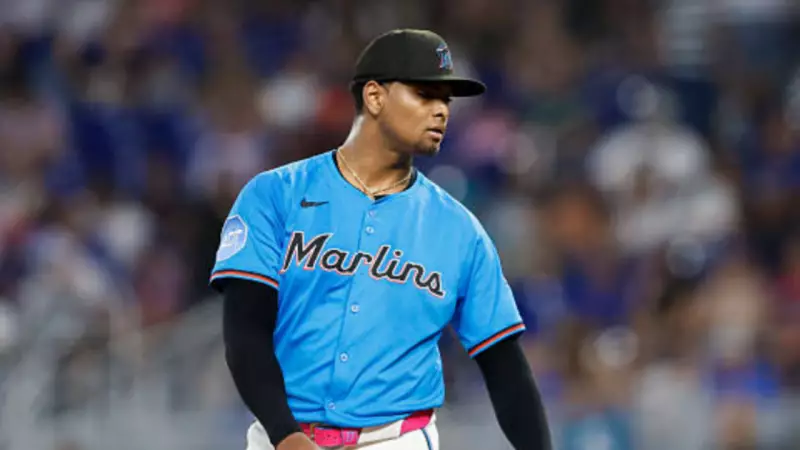
In a significant early-offseason move, the Chicago Cubs have acted decisively to strengthen their pitching staff by acquiring right-handed starter Edward Cabrera from the Miami Marlins. This trade signals the Cubs' clear intention to build on their competitive 2025 campaign and address rotation depth head-on.
Trade Details: Cubs Send Top Prospect to Marlins
The cost for securing Cabrera's services was substantial, highlighting Chicago's urgency for immediate help. To complete the deal, the Cubs parted with outfielder Owen Caissie, the organization's top-ranked prospect. Alongside Caissie, two infield prospects, Cristian Hernandez and Edgardo De Leon, were sent to Florida.
The 23-year-old Caissie is viewed as a future middle-of-the-order power bat, having shown improved plate discipline. Hernandez and De Leon add valuable depth at key defensive positions. For the Marlins, this trade continues their strategy of acquiring young, controllable position-player talent as part of a broader, long-term roster reconstruction.

What Edward Cabrera Brings to the Cubs
The 27-year-old Cabrera is coming off one of his best professional seasons, posting a 3.53 ERA across 30 appearances while setting a career-high in innings pitched. Despite a slender frame, his arsenal features a high-velocity fastball and a devastating changeup, offering flashes of frontline starter potential when he is healthy.
Chicago's front office was particularly attracted by Cabrera's recent improvements in command and pitch efficiency, seeing past earlier durability concerns. Importantly, the pitcher comes with multiple years of team control, providing not just immediate talent but also future stability.
Impact on the Cubs' 2026 Rotation Plans
Cabrera slots directly into a Cubs rotation that already features established arms like Shōta Imanaga and Jameson Taillon. His addition provides crucial stability and eases the innings burden on the staff's top pitchers.
The rotation's depth is expected to increase further when Justin Steele returns from elbow surgery early in the season. This acquisition arguably gives Chicago its deepest pitching staff in several years, a critical component for transforming last season's near-playoff miss into a genuine postseason run.
Financially, the move also offers the Cubs flexibility. With Cabrera out of arbitration options after this winter, his cost-controlled contract allows the front office potential payroll space to pursue offensive upgrades later in the offseason.
This major trade underscores a win-now mentality for the Cubs, who are willing to leverage premium prospect capital for proven major-league pitching. For the Marlins, it's another step in their ongoing rebuild, focusing on a future built around young positional core.