Chess Security Debate: From 2015 Phone Scandal to 2026 Candidates Metal Detectors
The year was 2015. Veteran Grandmaster Pravin Thipsay, then 55 years old, had not secured a tournament victory in four long years. He arrived at the inaugural Dr. Hegdewar Open in Delhi with hopes of breaking his dry spell, but by the fifth round, he found himself confronting a bewildering nightmare.
Across the board sat Dhruv Kakar, a 19-year-old engineering student whose modest rating of 1575 suggested an easy match for the experienced GM. However, as the game progressed, Thipsay watched in growing disbelief as his pieces were systematically traded away with what he described as "clinical, engine-like precision."
The Shocking Discovery
After eighty-seven grueling moves, the teenager emerged victorious, leaving Thipsay at the other end of the board in utter disbelief. "The quality of moves was not matching his rating," Thipsay recalled in an interview with TimesofIndia.com. "There was a consistency of time taken by him irrespective of whether the move was obvious or not."

Suspicion immediately fell on the young player. In a scene straight from a thriller novel, Kakar was escorted to a private room following the match. Authorities conducted a thorough body search and discovered he was strapped with multiple mobile phones across his torso. He was also wearing an earphone so minuscule that it required a magnet for removal.
Thipsay eventually went on to win the tournament, ending his four-year drought, but the triumph was tainted by the sobering realization of how easily the integrity of chess could be compromised by digital signals.
Fast Forward to 2026: Global Security Obsession
The shadows of that 2015 incident have now grown into a global obsession within the chess community. At the ongoing FIDE Candidates tournament, the pinnacle event that determines the World Championship challenger, the atmosphere resembles a high-security facility more than a quiet library.
This intense security environment prompted World Number Two Hikaru Nakamura to launch a sarcastic verbal attack that has since gone viral across social media platforms.
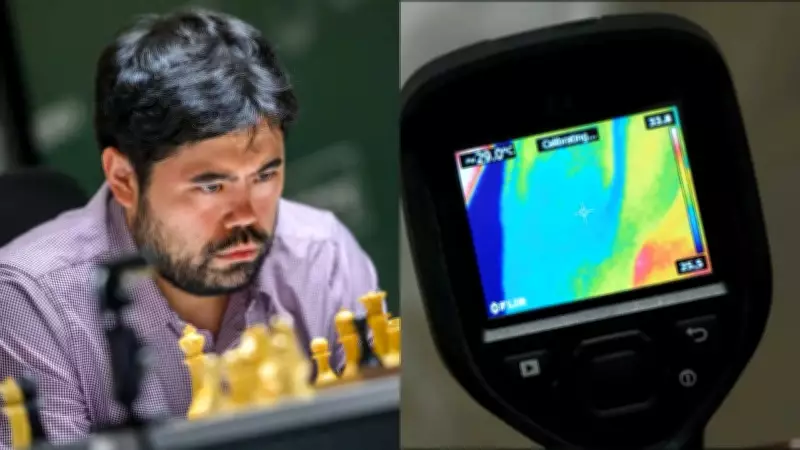
"They scan us before the game. They scan us after the game. They have metal detectors and a variety of other scanners," Nakamura scoffed on his popular YouTube channel. "I mean, who are we? Are we like Mossad agents inside Iran or something? Come on, we're chess players! Let's be real."
For Nakamura, these extensive measures represent "complete nonsense"—a theatrical overreaction to a threat he believes can be managed through existing technological safeguards. Yet FIDE remains steadfast in its approach.
FIDE's Firm Defense
Andy Howie, FIDE's Fair Play Officer, has vigorously defended the security protocols as essential protection for a World Championship qualifier. "We have to make sure the players are in a safe environment," he emphasized in a video statement on FIDE's official YouTube channel.
The debate has effectively split the chess world into opposing camps. Is FIDE genuinely protecting the game's integrity, or have they transformed a battle of wits into something resembling an airport security checkpoint?
The Indian Perspective
Shortly after Nakamura's rant, Koneru Humpy, India's legendary female Grandmaster, became one of the first Indian players to publicly voice support for the strict security measures.
"In today's era of rapid technological advancement, strong anti-cheating measures are essential," she noted on X (formerly Twitter). "They may feel demanding, but they ensure games are decided by skill. There have been times of doubt during games, but existing rules make it difficult to speak openly."
GM Shyam Sundar M echoes Humpy's sentiment while acknowledging the frustration Nakamura describes. "It is an absolute must because these days so many technologies keep coming up," Shyam explained. "I know how annoying it is. Before the game, players are usually focused only on the board. A long queue for ten minutes or more can be frustrating."

He added a crucial perspective: "What annoys a player even more than the waiting time is if someone cheats and never gets caught. So, for the benefit of the game, I think it is essential. Like in the airport, the security check is for our own safety. Once this is done, we know whether we are playing human players or 'meta-humans.'"
A Radical Alternative: Killing the Live Feed
While Nakamura rails against the scanners, Pravin Thipsay proposes a radical alternative that could potentially render metal detectors obsolete: eliminate live broadcasting of games.
"Cheating is a major threat. Any Tom, Dick, and Harry with the help of an engine could beat the world champion," Thipsay explained. "I think live chess is not a necessity. If the games are delayed by one hour, it's not going to affect the popularity of chess. It's not like a cricket match where people want to see the match live. People look at these games at their convenience."
Thipsay argues that FIDE is "mistaken" in believing that popularity depends on instant data availability. He highlights the logistical challenges the current rules create for traveling professionals.
"When we go abroad, we don't know where to leave our phones. You need a mobile to reach the location, but you can't leave it with the organisers, and you can't take it to the hall. It's a serious inconvenience," he elaborated.
His proposed solution involves delaying broadcasts by thirty to sixty minutes. "In that case, the cheating chances are almost zero. Players are happy to see even 100-year-old games. The priority should be that nobody has the privilege of showing the games while they are in progress."
The Price of Integrity
For younger Grandmasters like Abhimanyu Puranik, who recently turned 26, the extensive security measures represent simply the cost of competing at the highest level.
"Anti-cheating measures are of paramount importance nowadays," Puranik told TimesofIndia.com. "While obviously nothing suspect is going on in events like the Candidates, these events set an example for the quality of anti-cheating that tournaments around the world should aspire to."
Puranik acknowledges the process can be inconvenient but maintains: "It is a small price to pay for the greater good of the game."
While Nakamura might feel like a spy operating in hostile territory, many Indian players carry the memory of that 2015 incident—where an average-rated player executed god-like moves—as a ghost they are not prepared to stop hunting.
For now, the scanners and security protocols show no signs of disappearing. As long as the threat of technological cheating persists, Grandmasters will continue navigating security measures that make them feel less like chess players and more like secret agents protecting the soul of their ancient game.