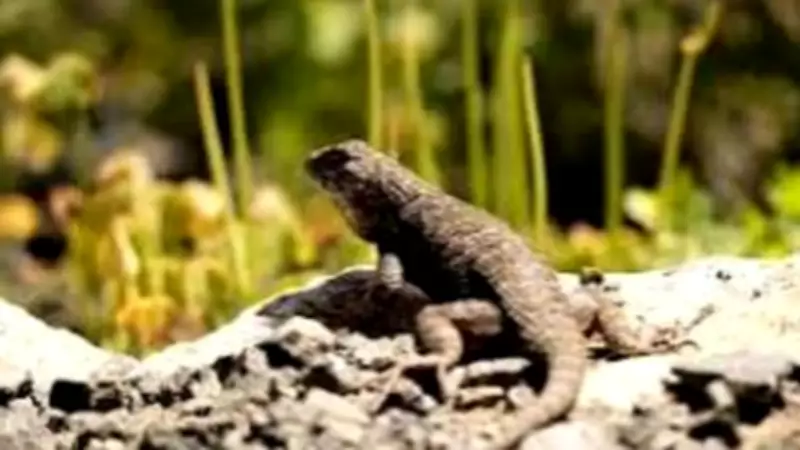
Imagine being a predator looking for an easy meal. You spot a small lizard basking on a rock and move in for the attack. At once, its tail detaches and begins to dance in front of you. Maybe this little lizard inflates itself like a balloon, shows a bright-colored frill around its neck, or if you are not so lucky the lizard shoots blood from its eyes.
This could be something straight from a science fiction film, but these are actual strategies lizards adopt to defend themselves from predators. Although they seem frail creatures, lizards, throughout millions of years of evolution, have managed to develop some of the strangest survival methods.
Dropping the Tail: The Ultimate Sacrifice
The most popular defence mechanism for lizards is tail autotomy, where the reptile deliberately detaches its tail upon being attacked. When the tail gets captured by the attacker, it detaches itself from the rest of the lizard's body through specific weak spots in the vertebrae. However, what is remarkable is how the detached tail continues moving, twisting, flipping, and even leaping away to distract the attacking animal long enough for the lizard to escape.

An amazing fact noted in National Geographic is that separated gecko tails are able to make quite complicated motions lasting as long as half an hour, which allows them to confuse the predator even further. Unfortunately, this trick comes at a price for the lizard. Its tail contains fat deposits and is used for balancing. Even though giving it up is a significant loss, it would be even more tragic to sacrifice one's life.
The Lizard That Shoots Blood from Its Eyes
If dropping the tail seems weird enough to you, then just wait until you learn about the horned lizard. Several species are capable of shooting jets of blood from their eye sockets when in danger. This trick, called autohaemorrhaging, takes place due to the fact that the blood pressure builds up in special sinuses near the eye sockets causing small blood vessels to burst.
Horned Lizards Use Blood-Squirting on Predators Such as Coyotes and Foxes, National Geographic reports. The blood is said to have components which are highly offensive to the dog family, making them move away out of discomfort.
According to Live Science, there is a lizard that can do more than shoot out blood from its eyes; it can also puff up and show off its sharp spines. It has been observed that the blood can shoot as far as five feet. A message that cannot be any clearer than, "Eat me and you will rue the day."
Too Big to Swallow
Not all lizards attempt to flee from predators, choosing rather to convince the predator that eating them is too difficult a task. Certain species of lizards, such as the bearded dragon and the horned lizard, can fill their lungs with air and thus greatly increase in size within a few seconds. This poses a problem for those predators who hunt by consuming the prey in its entirety. This tactic, when used together with spines, flattening the body, and acting aggressively towards the attacker, can prove highly effective.
The Art of Appearing Frightening
The Australian frilled lizard is a master at appearing frightening to its prey. Upon sensing a threat, it rises on its legs, opens its mouth, hisses, and spreads a circular frill around its neck. It makes the lizard seem twice its size. Amazingly, the lizard often comes out victorious without even coming into contact with the predator. Most predators usually realize it’s not worth the effort. Indeed, many times, scaring away an enemy can be more successful than posing a threat to it.
Acting Like You Are Playing Dead
Some lizards adopt an entirely new strategy altogether. Rather than fleeing or defending themselves, they freeze in place and play dead. Known as thanatosis, this process consists of staying absolutely still for long periods of time. Certain lizards even lie on their back with their mouth hanging open. Predators have been conditioned to respond to movement. A still creature might suddenly look like less of a choice compared to a moving target nearby. One of the most basic defences possible, it is nevertheless surprisingly effective.

Disappearing Without Moving an Inch
Every defence does not need flashy moves. Some lizards manage to avoid being hunted because their predators never spot them in the first place. Desert, woodland, and stone-dwelling lizards tend to have camouflage that blends in perfectly with their environments. Rather than moving about frantically, they stand perfectly still and rely upon their camouflage. The trick works due to the way some predators see the world. Movement is far easier to perceive than form.