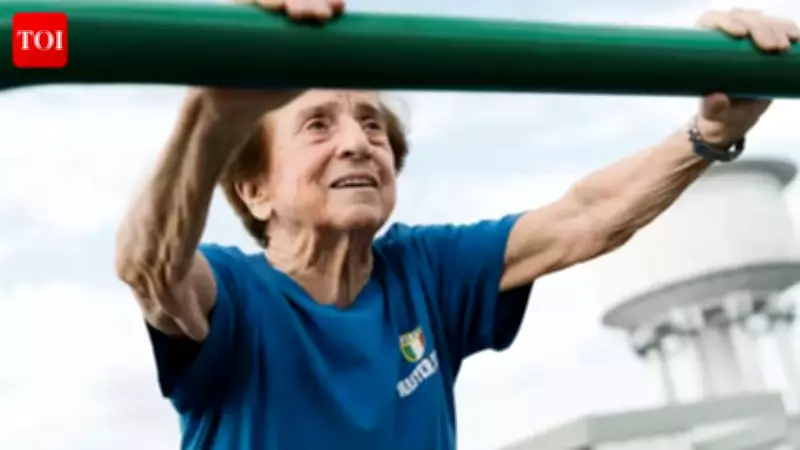
Most people in their 90s are told to slow down. Emma Maria Mazzenga says, “No, thanks,” and heads to the track. For the last several years, Emma, who is 92 and lives in Padua, Italy, has been busy shattering world records, outrunning women decades younger, and leaving researchers wondering if they need to toss out everything they thought they knew about what is possible in old age.
Scientists Study Emma Mazzenga's Remarkable Physiology
Scientists in Italy and the US have started studying her, inside and out, because her body, by several key measures, looks far younger than her birth certificate says. In some ways, her fitness rivals that of folks in their 20s, 30s, even 50s. Sure, her story is inspiring on the surface: a remarkable athlete, defying the odds. But it is more than that. Emma has become a kind of real-life case study, teaching researchers, and the rest of us, about how daily choices, genes, and maybe a sprinkle of luck shape how we age. And maybe best of all, her story holds useful lessons for the rest of us, even if running a 200-meter race is the last thing on our minds.
The Fastest 92-Year-Old on the Planet
Ask just about anyone in masters track circles, and they will tell you: Emma Mazzenga is the fastest woman her age in the world. According to CNN, she has stacked up world records left and right in the 90-94 age group, including indoor records for the 60-meter, 200-meter, and 400-meter, plus the outdoor 200-meter. In recent years, she has raced herself more than her peers because, let's be honest, there simply aren't many competitors left in her division. But here is what is even more mind-bending: she isn't just getting by; she is thriving. According to The Washington Post, scientists at the University of Pavia, along with US colleagues, recently put her through a battery of tests. They wanted to figure out which parts of aging really are inevitable, and which ones we can hold at bay with the right habits. Even they didn't expect the results they found.

Emma Mazzenga's Body Is Decades Younger Than Her Age
Emma's aerobic fitness? Turns out, that is right on par with strong, athletic women half her age. Per The Post, her heart and lungs send oxygen to her muscles like a well-oiled machine, almost as efficiently as women in their 30s. And the mitochondria in her muscles work almost as well as those in healthy twentysomethings. Even her nerves and muscles communicate better than in most folks her age. Usually, those connections break down as we get older, causing weakness and instability, but not for Emma. In her, a lot of this communication is going strong. She hasn't completely dodged aging, though. She has lost some muscle mass, and her fastest muscle fibers (the ones responsible for explosive movements) have shrunk some. Still, all told, her body has held onto the kinds of strength, speed, and coordination most people lose years, sometimes decades, earlier. “She is aging,” one researcher said, “but doing things almost nobody else in their 90s can.”
What Is the Secret? No Magic Bullet, Just Simple Habits
Whenever Emma's story goes public, everyone asks the same thing: What is her secret? Is it some miracle diet, special genes, or a weird cutting-edge therapy? Turns out, it is almost boringly simple.
Emma's Training Routine
For starters, her exercise routine is straightforward. Reports and interviews all say pretty much the same: three days a week, give or take. It is not an hour-long grind on the treadmill. Instead, she focuses on sprints: short bursts of all-out running, broken up with plenty of recovery. Those quick, hard efforts keep her muscles strong and her heart and nerves sharp. That is key, experts say, because sprinting uses the “fast-twitch” muscle fibers responsible for speed and power, the same ones that tend to fade fastest with age if you don't use them. Besides the sprint sessions, she walks a lot and keeps generally active throughout the week. No expensive gym required; just lots of regular movement, woven into daily life. That might be the biggest reason she has stayed so healthy for so long.

However, what comes up as a more interesting aspect is that Emma didn't train nonstop her whole life: she hasn't been a lifelong athlete, actually. She ran sprints in college while studying biology, but then life happened. She immersed herself into work, family, and the usual pattern. There were long stretches (more than a decade) where exercise took a back seat. Emma got back into sprinting in her mid-40s, bit by bit. By then, she hadn't trained seriously in ages. But she rebuilt her fitness and, ever since, hasn't stopped. She is proof it is not too late: the body can bounce back, even if you didn't peak as an athlete in your youth. In fact, researchers emphasize this again and again: big improvements can show up at any age, not just if you started young.
Emma's Impressively Simple Diet
If you are thinking her diet must be some secret anti-aging protocol, don't hold your breath. Emma eats what most Italians do: fish, vegetables, eggs, rice, pasta, fruit, the odd bit of meat. No weird superfoods, no rigid food rules, no expensive supplements. She eats well. She eats enough. She enjoys her food. It is pretty much what nutritionists have been recommending forever: balance, moderation, lots of produce, and enough protein to keep muscles happy. Again, it is about keeping up with simple, steady habits, year after year.
The Takeaways from a 92-Year-Old Sprinter
So what actual, actionable lessons can people learn? First and foremost, movement is medicine. Regular activity, especially movements that challenge your heart, muscles, and coordination, slows down a lot of what we think of as “aging.” You can't stop time, but you can turn back some of its effects. Second, it is less about working out harder and more about just showing up, again and again. Emma is not training like an Olympian. She has just built it into her life and stuck with it. Third, there is more to aging well than exercise. Diet, mental stimulation, family, friends, a positive outlook, they all count.
Scientists are still learning from Emma Mazzenga, studying her physiology as she nears 93, and looking for clues about how the rest of us can hold onto strength, independence, and sharp thinking as we age. That work is ongoing. But her most important legacy may be what she represents. In a culture that sees aging as an unavoidable downhill slide, Emma's trajectory of aging is a breath of fresh air. At 92, she is still running, still training, still making plans. She is a living testament that, while you can't choose how many birthdays you have had, you do have power in how you show up, year after year.