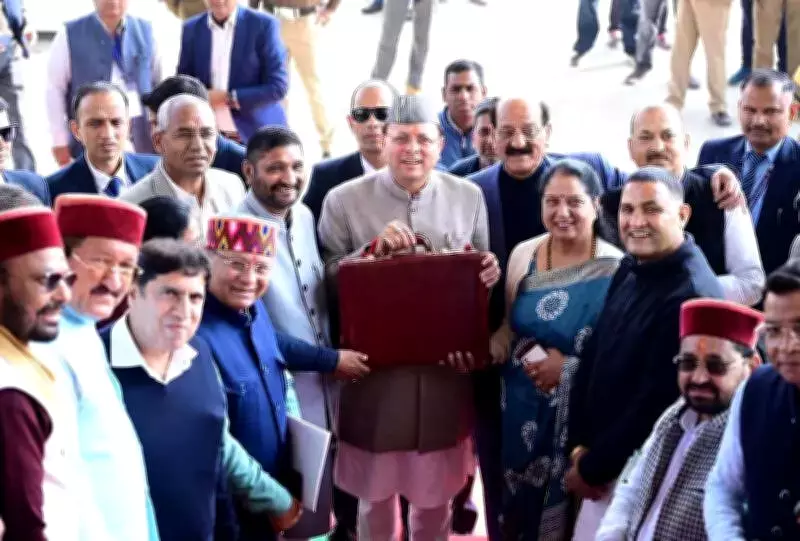
Uttarakhand Government Presents Rs 1.1 Lakh Crore Budget for 2026-27
In a significant move aimed at bolstering infrastructure across both urban and rural regions, the Uttarakhand government, led by Chief Minister Pushkar Singh Dhami, presented a substantial budget of Rs 1.1 lakh crore for the fiscal year 2026-27. This financial plan was unveiled in the state assembly on Monday, marking an approximate 10% increase from the Rs 1.01 lakh crore outlay of the 2024-25 budget. The budget underscores a commitment to comprehensive development through strategic allocations and innovative models.
GYAN Model: A Pillar for Holistic Development
Chief Minister Pushkar Singh Dhami, while presenting the budget, highlighted the government's focus on the GYAN model, which stands for gareeb (poor), yuva (youth), annadata (farmers), and nari (women). He described this as a balanced approach designed to lay a robust roadmap for the state's future progress. "Through the GYAN model, we aim to accelerate the upliftment of the poor, empower the youth, ensure prosperity for farmers, and foster the social and economic development of women," Dhami stated. He emphasized that this model would inject new momentum into these critical areas, driving Uttarakhand towards sustainable growth.
Financial Breakdown and Fiscal Management
The budget details reveal a meticulous financial structure, with revenue expenditure pegged at Rs 64,989 crore and capital expenditure at Rs 46,713 crore. The fiscal deficit is projected at Rs 12,579 crore, which remains below 3% of the Gross State Domestic Product (GSDP), adhering to the limits set under the Fiscal Responsibility and Budget Management (FRBM) Act. Additionally, the primary deficit is estimated at Rs 4,650 crore. Revenue receipts for 2026-27 are anticipated to reach Rs 67,525 crore, while capital receipts are forecasted at Rs 43,617 crore. Key components include:
- Tax revenue contributing Rs 43,327 crore
- Non-tax revenue projected at Rs 24,198 crore
- Internal debt estimated at Rs 27 crore
- Loans and advances from the Centre amounting to Rs 42,590 crore, pushing the state's public debt beyond Rs 21,000 crore
Infrastructure and Welfare Initiatives
A significant portion of the budget is dedicated to enhancing infrastructure and supporting welfare programs. Notably, Rs 1,027 crore has been earmarked for the upcoming Kumbh Mela, scheduled to commence on January 14, 2027. Infrastructure allocations include:
- Rs 2,501 crore for the Public Works Department
- Rs 1,401 crore for the Urban Development Department
- Rs 1,642 crore for Rural Development
- Rs 291 crore for Housing initiatives
Welfare schemes receive substantial funding, with highlights such as Rs 1,300 crore for the Annapurti Yojana, Rs 298.3 crore for Pradhan Mantri Awas Yojana (Gramin), and Rs 56.1 crore for PMAY (Urban). Other key allocations encompass Rs 25 crore for housing for economically weaker sections, Rs 42 crore for free bus travel for designated passengers, and Rs 43.03 crore as a subsidy on cooking gas. Social security pensions, including programs for physically challenged beneficiaries and the Teelu Rauteli initiative, are allocated Rs 167.05 crore, while Rs 25 crore is set aside for rehabilitating disaster-affected families.
Sector-Specific Allocations
The budget also addresses various sectors with targeted funds:
- Youth and Employment: Rs 60 crore for Mukhyamantri Swarojgar Yojana, Rs 10 crore for Palayan Roktham Yojana, Rs 62.2 crore for Pandit Deendayal Upadhyaya Gramin Kaushal Yojana, Rs 155 crore for assistance to non-government colleges, Rs 10 crore for honorarium of Shiksha Mitras, and Rs 10 crore for Mukhyamantri Yuva Bhavishya Nirman Yojana.
- Agriculture: Rs 39.9 crore for Trout Protsahan Yojana, Rs 42 crore for Mission Apple, Rs 32 crore for incentives to milk producers, Rs 42.5 crore for Deendayal Upadhyaya Sahkarita Kisan Kalyan Yojana, Rs 160 crore for Pradhan Mantri Matsya Sampada Yojana, Rs 12 crore for Millet Mission, Rs 12 crore for Kisan Pension Yojana, and Rs 705 crore under the VB-G RAM G project for farmers.
- Women's Development: Rs 220 crore for Nanda Gaura Yojana, Rs 47.7 crore for Pradhan Mantri Matritva Vandana Yojana, and Rs 30 crore for Mukhyamantri Mahalakshmi Kit Yojana. The gender budget has seen a notable increase, rising from Rs 16,961 crore in 2025-26 to Rs 19,692 crore in 2026-27.
Political Criticism and Opposition Response
Despite the government's optimistic outlook, the budget has faced criticism from opposition parties. Uttarakhand Congress chief Ganesh Godiyal labeled the budget as "directionless, regressive, anti-development, and election-oriented." He argued that the BJP government has failed to present a clear strategy to tackle pressing issues such as unemployment and migration in the hill state. "Rising unemployment remains the most significant challenge today, yet the budget lacks a concrete plan for providing permanent employment to the youth. Migration from hill areas is a serious concern, but no effective strategy to curb it has been outlined," Godiyal remarked, highlighting gaps in the proposed financial plan.
Overall, the Uttarakhand budget for 2026-27 represents a ambitious effort to drive development through increased spending and focused initiatives, though it continues to spark debate over its effectiveness in addressing core socio-economic challenges.