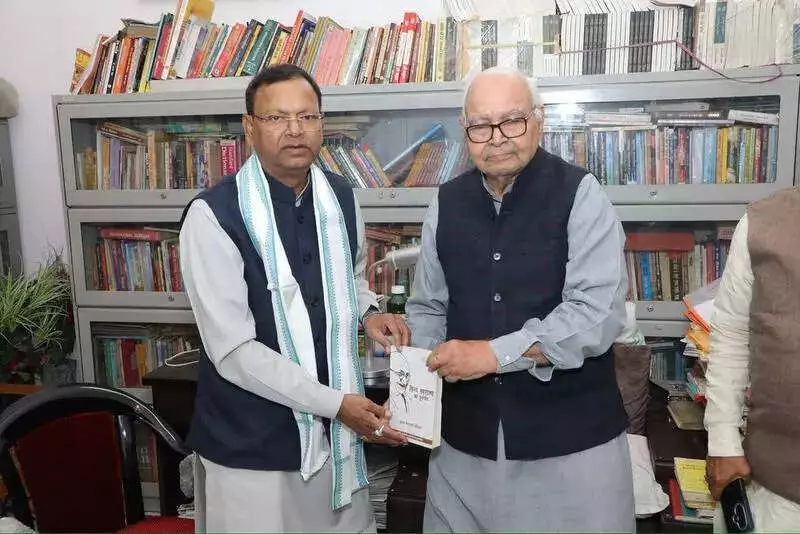
In a significant move to consolidate the party's structure, newly appointed Uttar Pradesh Bharatiya Janata Party (BJP) president Pankaj Chaudhary has initiated a series of meetings with his predecessors and senior party veterans. This outreach comes just a week after he assumed the crucial organisational role and is aimed at bolstering the party's command ahead of the 2025 panchayat elections and the 2027 Uttar Pradesh assembly polls.
Building Bridges with the Old Guard
Sources within the party indicate that Chaudhary plans to personally meet all former UP BJP presidents and senior leaders who have held key organisational positions in the past. Demonstrating this intent, on Monday, he held meetings with former state chiefs Vinay Katiyar and Swatantra Dev Singh. He has also met with former UP Assembly Speaker Hriday Narain Dixit and the current Speaker, Satish Mahana.
"My idea is to engage all senior leaders and gain from their experiences. I want to take everyone along. That's my style of working," Chaudhary told the Times of India. A senior BJP functionary explained that the new state chief is actively engaging with senior leaders to integrate them into the active command chain while simultaneously understanding the nuanced dynamics of the party's organisation.

A Strategic Move for Organisational Cohesion
Political experts view Chaudhary's outreach as a strategic attempt to consolidate his authority while addressing any existing organisational fault lines. Leadership transitions in the state BJP have historically, at times, led to the creation of parallel power centres, with some former state chiefs continuing to exert influence within their regional and caste-based networks.
Chaudhary, who is the fourth Kurmi community leader to become the state president after Katiyar, O.P. Singh, and Swatantra Dev Singh, is reportedly evaluating all options to strengthen the party's social coalition. This coalition, comprising non-Yadav Other Backward Classes (OBCs) and non-Jatav Scheduled Castes (SCs), has been instrumental in the BJP's rise as a political powerhouse in Uttar Pradesh under Prime Minister Narendra Modi.
Preparing for the Panchayat Litmus Test
The immediate focus of this consolidation effort is the upcoming panchayat elections, which will serve as a critical test for the BJP's organisational strength and its caste and social calculations. These local polls are particularly significant in areas where veteran leaders still hold considerable clout.
Analysts suggest that rejuvenating and involving the old guard could serve a dual purpose: it helps the party counter potential anti-incumbency sentiments at the grassroots level and works to neutralise internal factionalism. Sources say Chaudhary's approach reflects his acknowledgment that experience remains indispensable in a politically complex state like Uttar Pradesh.
The ensuing panchayat polls are seen as a litmus test for Chaudhary's organisational grip, with the 2027 assembly elections looming as the ultimate benchmark. "By reaching out early, he is signalling an intent to build a broad-based organisational consensus while remaining deeply connected with the party's central leadership," a senior BJP functionary noted.