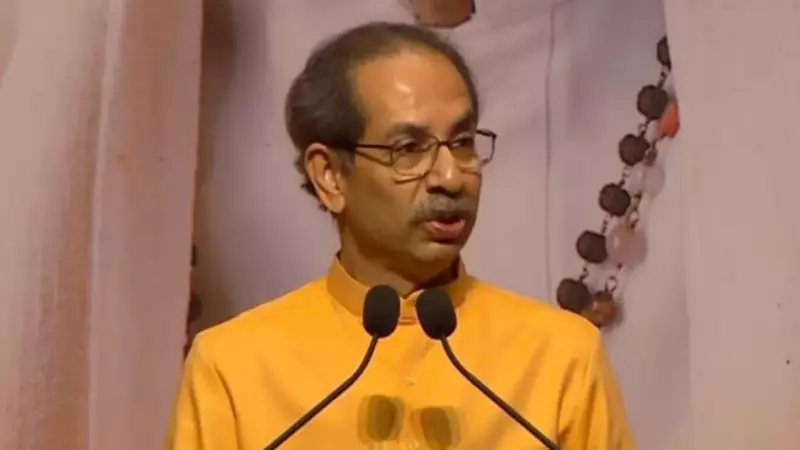
NEW DELHI: In a defiant response to his party's electoral setback, Shiv Sena (UBT) chief Uddhav Thackeray has launched a vigorous attack on the Bharatiya Janata Party, asserting that the saffron party is mistaken if it believes Shiv Sena can be destroyed. The former Maharashtra chief minister's remarks came during a significant address to party workers, marking the 100th anniversary of Balasaheb Thackeray's birth, where he framed Shiv Sena not merely as a political entity but as an enduring ideological force.
Shiv Sena as an Ideological Torchbearer
Thackeray emphatically declared that Shiv Sena represents far more than conventional political machinery. "Shiv Sena is not just a political party," he stated, directly challenging BJP's perceived assumptions about his organization's vulnerability. "And if the BJP thinks that Shiv Sena will finish it off, you cannot finish Shiv Sena."
Elaborating on this philosophical foundation, the Shiv Sena leader articulated a vision of his party as an embodiment of regional identity and resistance. "You cannot destroy Shiv Sena because Shiv Sena is not a party. Shiv Sena is an ideology. Shiv Sena is the embodiment of the sons of the soil. And Shiv Sena is the torch burning in the hearts of the oppressed; you cannot extinguish it. You absolutely cannot extinguish it."

Historical Context and Political Accusations
Thackeray contextualized the current political landscape by reminding listeners of Shiv Sena's historical significance to BJP's own political trajectory. He claimed, "Had the Shiv Sena not been there, the BJP would have never seen the inside of the BMC or mantralaya," referencing both Mumbai's municipal corporation and the state government headquarters. This statement, reported by news agency PTI, underscores his argument about Shiv Sena's foundational role in Maharashtra politics.
The response represents Thackeray's first public commentary since BJP emerged as the largest party in the Brihanmumbai Municipal Corporation elections, securing 89 out of 227 seats in the January 15 polls. This outcome ended the Thackeray family's decades-long dominance over India's wealthiest municipal body.
Allegations of Electoral Irregularities
Dismissing the ethical legitimacy of BJP's victory, Thackeray leveled serious accusations about the conduct of the civic polls. He asserted that "money power was used for the first time during the civic polls in the city," suggesting unprecedented financial influence in the electoral process.
Furthermore, he detailed specific obstacles faced by opposition parties, including:
- Flawed electoral rolls that created administrative hurdles
- The presence of dual voters that required identification efforts
- Systemic challenges that potentially altered electoral outcomes
Thackeray maintained that "the result would have been even more different had the Sena (UBT) not identified dual voters," indicating his belief that his party's vigilance prevented an even more unfavorable outcome.
Future Prospects and Cultural Concerns
Despite the disappointing electoral performance, Thackeray expressed measured optimism about Shiv Sena's continuing role in Mumbai's governance. "The BMC results may not be as per what the party desired, but the Opposition is a strong force in the civic body," he observed, while simultaneously accusing BJP of expansionist ambitions toward India's financial capital.
In a striking allegation, Thackeray claimed that "the BJP wants to swallow Mumbai," framing the political contest as a struggle for the city's soul and resources. This characterization aligns with his broader critique of BJP's cultural approach to Maharashtra.
Cultural Identity and Regional Pride
The Shiv Sena leader extended his criticism beyond immediate political competition to address deeper cultural concerns. He accused BJP of attempting to impose non-Marathi culture on Maharashtra, positioning his party as the defender of regional identity and traditions.
In a symbolic gesture reinforcing this cultural stance, Thackeray urged everyone to adopt "Jai Maharashtra" as a common greeting, promoting linguistic and regional pride as counterweights to what he perceives as homogenizing forces.

Looking Forward with Renewed Purpose
Thackeray framed the electoral setback as an opportunity for renewal rather than defeat. "We have to start afresh," he declared, connecting this forward-looking perspective to Shiv Sena's foundational principles. He emphasized that "the Sena was born not for power but for fighting for the rights of Marathi manoos," reinforcing the party's original mission of advocating for the Marathi-speaking population.
This comprehensive address by Uddhav Thackeray represents both a response to immediate political developments and a strategic repositioning of Shiv Sena as an ideological movement rather than merely an electoral competitor. By emphasizing cultural identity, historical significance, and philosophical resilience, Thackeray seeks to transform an electoral defeat into a narrative of enduring purpose and future resurgence.