Telangana's Naxal Conflict: Surrender Wave Dominates Four-Decade Battle
As security forces intensify nationwide operations to eliminate Left Wing extremism, Telangana's protracted four-decade struggle against Naxalism is receiving renewed focus, characterized by a significant wave of surrenders that vastly exceed arrests or encounter fatalities.
Surrender Statistics Highlight Strategic Shift
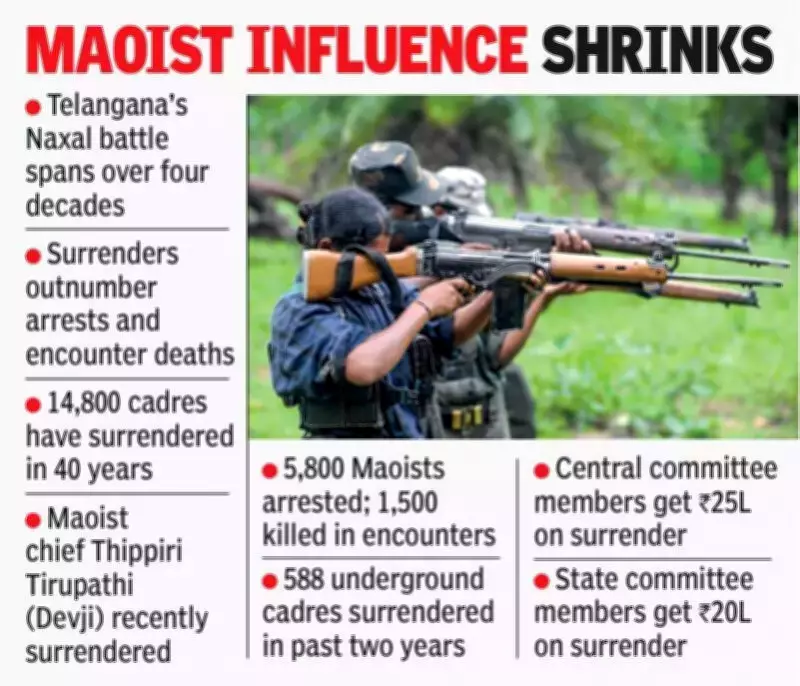
Official data reveals that approximately 14,800 cadres from various Left Wing extremist groups, including the Communist Party of India (Maoist), have surrendered in Telangana over the past 40 years. This figure is poised to increase with the anticipated formal confirmation this week of the reported surrender of Thippiri Tirupathi, alias Devji, believed to be a Maoist general secretary, along with a substantial group of cadres.
During the same period, security agencies arrested around 5,800 Maoists for involvement in subversive activities, while roughly 1,500 were killed in encounters across the state. These numbers underscore that surrender has emerged as the predominant pathway out of the insurgency, reflecting a strategic weakening of militant networks.

Recent Trends and Rehabilitation Incentives
Over the past two years alone, 588 underground cadres of the Maoist party across various ranks have surrendered before Telangana police, indicating a steady erosion of the insurgent infrastructure in the region.
To encourage defections, the state government offers substantial rehabilitation incentives. A central committee member who surrenders is eligible for 25 lakh rupees, while a state committee member receives 20 lakh rupees. Sources indicate that proposals have been submitted to the Ministry of Home Affairs seeking enhanced packages, with the MHA potentially offering up to 1 crore rupees for a central committee member's surrender.
Officials emphasize that the objective is to ensure former militants can rebuild their lives with dignity. Police are actively sending proposals to facilitate better rehabilitation for surrendered Naxals, providing them with reliable means to lead dignified lives post-surrender.
Policy Implementation and Unresolved Issues
Telangana continues to implement a surrender-cum-rehabilitation policy introduced in 2012 during the undivided Andhra Pradesh era. However, some long-standing demands remain unaddressed. Many surrendered cadres have sought allocation of agricultural land, a promise that has largely remained unfulfilled.
While every Maoist receives financial assistance immediately upon surrender, other anticipated benefits have often been elusive. Despite these challenges, sources note that in recent decades, the replacement of surrendered Naxalites within the banned outfit has been negligible, highlighting the effectiveness of the surrender strategy in disrupting militant recruitment and continuity.