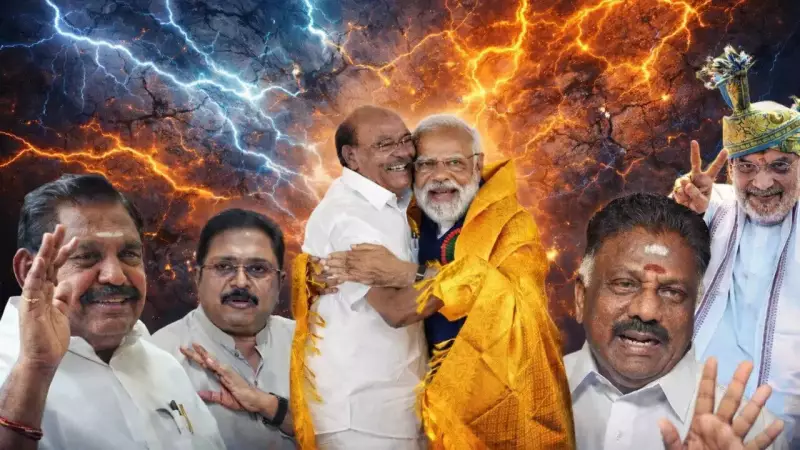
A high-stakes, late-night meeting in Delhi last week between Union Home Minister Amit Shah and AIADMK general secretary Edappadi K. Palaniswami (EPS) has laid bare the significant strains within the National Democratic Alliance (NDA) in Tamil Nadu. While framed as routine alliance talks for the crucial 2026 Assembly elections, the discussions highlighted a fierce struggle for control that threatens the coalition's unity against the ruling Dravida Munnetra Kazhagam (DMK).
The Core Demand: A Pre-Poll Power-Sharing Pact
At the heart of the tension is a bold demand from the Bharatiya Janata Party (BJP) that goes beyond traditional seat-sharing arithmetic. Reports indicate the BJP is seeking a formal, pre-election assurance of power-sharing from the AIADMK. This includes a claim for at least three cabinet berths in the event that an AIADMK-led NDA forms the next government in Tamil Nadu.
For a state with a political culture deeply rooted in Dravidian assertion and regional autonomy, such an explicit demand for a share in governance before votes are cast is virtually unprecedented. The reaction within the AIADMK ranks has been one of deep wariness, if not outright resistance, especially given the BJP's still-limited grassroots clout in the state.

BJP's Strategic Calculus and the Urgency for Control
For the BJP, Tamil Nadu remains the most challenging large state on India's electoral map. Despite a decade of organizational work and a gradually increasing vote share, the party has failed to convert presence into tangible power. Its alliance with the AIADMK is, therefore, viewed in Delhi as the primary vehicle for achieving political relevance in the south.
This urgency is reflected in the current strategy, curated by Amit Shah. The BJP has moved away from its earlier role as a junior partner contesting a limited number of seats. It now proposes that the BJP and its smaller allies together contest around 56 of the state's 234 assembly seats. The insistence on cabinet representation is a strategic signal to both its cadres and the electorate that the BJP aims to be a direct stakeholder in governance, not just a supporting actor.
This push coincides with a renewed effort by the central leadership to rebuild a broader NDA, courting former allies and breakaway factions like the Pattali Makkal Katchi (PMK) to prevent anti-DMK votes from splitting. However, this centralized approach risks reviving the potent Tamil Nadu narrative of resistance to "Delhi control," which could become a liability for the AIADMK.
AIADMK's Dilemma: Survival, Strategy, and Internal Fractures
For the AIADMK, the alliance negotiations are a tightrope walk between survival and strategy. Since the death of its towering leader J. Jayalalithaa in 2016, the party has struggled to regain its dominant position. In the 2021 state polls, the AIADMK-led alliance won 75 seats (AIADMK-66), while the DMK-led front swept to power with 159 seats.
Post this defeat, EPS moved decisively to consolidate his authority, marginalising rival O. Panneerselvam (OPS) and asserting himself as the party's sole leader. While this solidified his internal control, the EPS-OPS split narrowed the party's social and political reach at a critical time. The BJP finds this internal fracture uncomfortable, viewing OPS as more approachable, yet cannot ignore EPS's authority without jeopardizing the alliance.
EPS's reluctance to publicly commit to power-sharing with the BJP stems from this complex calculus. He is also cautious about re-inducting expelled leaders like TTV Dhinakaran of the Amma Makkal Munnetra Kazhagam (AMMK), whose party, while not winning seats, dented AIADMK prospects in key regions in 2021. For the BJP, bringing such factions back is about vote consolidation; for EPS, it is a threat to his hard-won internal cohesion.
A Crowded Field: DMK, Vijay's TVK, and the Multi-Cornered Contest
The political landscape for 2026 is unusually fluid and crowded. The DMK, led by Chief Minister M.K. Stalin, is defending its record amid murmurs of alliance unease with the Congress and a gradual leadership transition to his son, Udhayanidhi Stalin. The party's strategy hinges on projecting stability against an "unstable and opportunistic" opposition.

Adding a major new variable is actor-turned-politician Vijay and his Tamilaga Vettri Kazhagam (TVK). While untested in elections, Vijay's cross-generational appeal positions his party as a potential spoiler or alternative, attracting voters disillusioned with both the DMK and the AIADMK-BJP combine.
The re-entry of the PMK into the NDA, despite giving a symbolic boost, comes with its own complications due to a public rift between leader Anbumani Ramadoss and founder S. Ramadoss, which weakens its vote-transfer capability.
As negotiations continue behind closed doors, Tamil Nadu is poised for a multi-cornered contest where perception and alliance management will be as critical as raw numbers. The NDA's current troubles—whether a prelude to a stronger front or a symptom of deeper contradictions—will define the battle to challenge the DMK's hold on power in 2026.