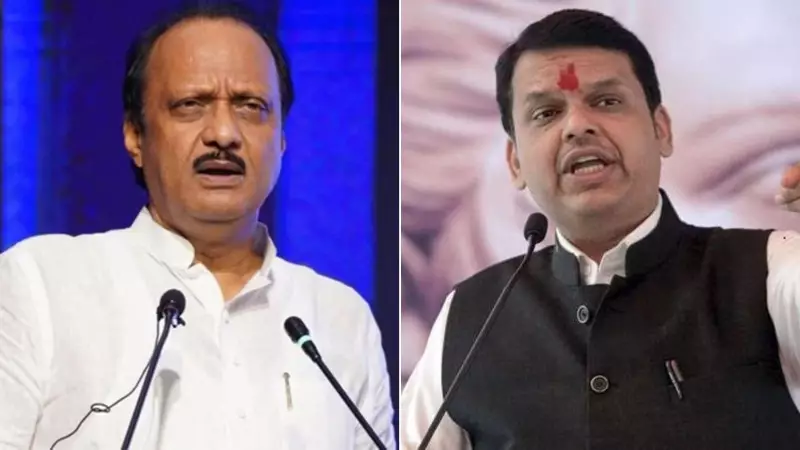
The political climate in Maharashtra has intensified ahead of the January 15 elections for 29 municipal corporations, with a sharp ideological rift now defining the strained partnership between the Bharatiya Janata Party (BJP) and the Ajit Pawar-led Nationalist Congress Party (NCP). What began as electoral sparring has morphed into a profound debate contrasting the legacies of Hindutva ideologue Vinayak Damodar Savarkar and the architect of the Constitution, Dr. B.R. Ambedkar.
From Alliance Friction to Ideological Confrontation
The friction reached a new peak when BJP leaders, responding to NCP's criticism on governance and corruption, invoked a historic 1937 statement by Savarkar. The quote, "If you come along with us, we are with you. If you do not, then without you. If you oppose us, then in spite of you, Hindutva shall prevail," was delivered by Savarkar during his tenure as president of the Hindu Mahasabha. BJP leaders used it to signal an uncompromising stance on core ideology.
State BJP president Ravindra Chavan and Cultural Affairs Minister Ashish Shelar emphasized the party's reverence for Savarkar. Shelar stated the BJP has never diluted its commitment to Hindutva for political expediency, while Chavan expressed an expectation for allies to show similar respect towards the ideologue. This move is widely seen as an attempt to corner the NCP, which relies on a broad secular vote bank including Muslims, by forcing an ideological litmus test.
NCP's Firm Rebuttal with Ambedkarite Legacy
The NCP responded swiftly and firmly, refusing to be boxed into the BJP's ideological framework. NCP state general secretary Amol Mitkari challenged the BJP's right to impose its ideology on others in a democracy. In a clear counter, he affirmed his party's commitment to the "Shiv-Shahu-Phule-Ambedkar" ideology, a reference to the social reform traditions of Chhatrapati Shivaji Maharaj, Rajarshi Shahu Maharaj, Jyotirao Phule, and Dr. Ambedkar.
Mitkari's post on social media platform X underscored this stance, suggesting that just as the BJP expects acceptance of its views, it must also acknowledge the NCP's Ambedkarite principles. This exchange highlights the complex historical relationship between Savarkar and Ambedkar, two figures who acknowledged each other's reform efforts but held fundamentally different views on caste, social justice, and nation-building.
Underlying Tensions and Electoral Calculus
This public row erupts at a time when the alliance's equation is at its lowest point. Several factors have contributed to the bitterness:
- The BJP's decision to contest most municipal corporations, including the crucial Brihanmumbai Municipal Corporation (BMC), without a formal alliance with the NCP.
- NCP's anger over the BJP aggressively expanding into its traditional political turf following the BJP's victory in the 2024 Maharashtra Assembly elections.
- The NCP's decision to ally with the Sharad Pawar-led NCP(SP) in the Pune and Pimpri-Chinchwad civic polls, which deeply upset the BJP.
- Persistent NCP attacks on the BJP over alleged corruption during the BJP's tenure in the Pimpri-Chinchwad Municipal Corporation from 2017 to 2022.
A BJP insider revealed that invoking Savarkar is a strategic move to consolidate majority Hindu votes under a firm Hindutva banner against a combined opposition front. This front includes the Uddhav Thackeray-led Shiv Sena (UBT), the NCP(SP), the Congress, and Prakash Ambedkar's Vanchit Bahujan Aghadi (VBA), which has allied with the Congress for the BMC polls.
Prakash Ambedkar, VBA president, interpreted the BJP's strategy as an attempt to counter the potential consolidation of Marathi, Muslim, and Dalit voters. He noted that unlike the united Mahayuti front seen in the 2024 Lok Sabha and Assembly elections, the local body polls have exposed and widened the cracks within the alliance.
The Savarkar-Ambedkar debate, therefore, is more than a war of words. It is a reflection of the intense political realignment and ideological positioning underway in Maharashtra as parties gear up for a high-stakes urban electoral battle, with alliances fraying and core voter bases being passionately appealed to.