Punjab Chief Minister Announces Major Breakthrough for Border Farmers
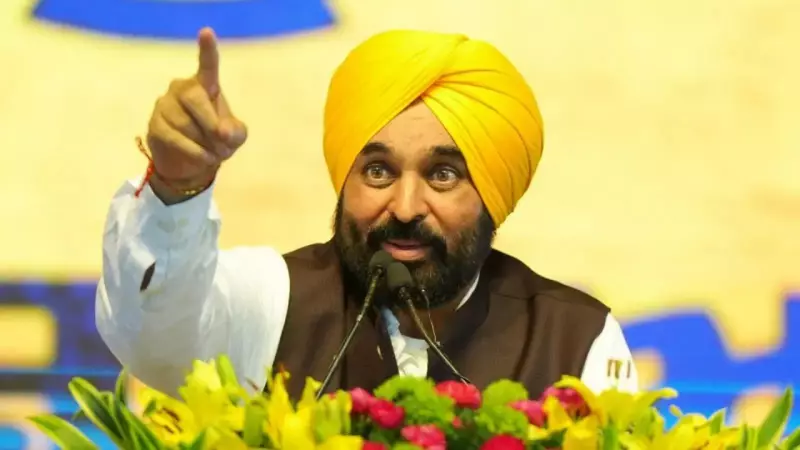
Punjab Chief Minister Bhagwant Mann declared a significant victory for farmers in the state's border regions on Saturday. This announcement followed his crucial meeting with Union Home Minister Amit Shah in New Delhi.
The central government has agreed in principle to relocate the security fence closer to the International Border with Pakistan. This decision promises to transform agricultural life along the sensitive frontier.
Ending Daily Hardships for Border Farmers
For years, farmers in Punjab's border belt have endured immense difficulties. They have been forced to cross the existing security fence with identity cards and under armed BSF escort just to reach their own fields.

This daily ritual created constant uncertainty along the 532-kilometer India-Pakistan border. The current fencing sits deep inside Punjab's territory, trapping thousands of acres of fertile farmland beyond its reach.
"The home minister informed me that this issue is under active consideration," Mann stated after the meeting. "The fencing will be shifted towards the border. This will bring Punjab's land back to the accessible side without compromising our national security."
This move will finally allow unhindered cultivation of those trapped farmlands. Farmers will no longer need special permissions and military escorts for basic agricultural work.
Multiple Long-Pending Issues Raised
Beyond the border fencing, Chief Minister Mann presented a comprehensive list of unresolved matters affecting Punjab. He demanded prompt and time-bound resolutions for each concern.
The chief minister specifically objected to the proposed Seeds Bill 2025. He argued the draft legislation fails to protect Punjab's interests as a major agricultural state.
"Punjab is an agrarian state and one of the largest grain producers in the country," Mann emphasized. "Yet the draft Seed Bill does not assure proper representation for the state."
He highlighted several critical flaws in the proposed legislation:
- The zone-based system does not guarantee Punjab's representation in the central seed committee
- The bill curtails existing powers of state seed committees
- No role is envisaged for state-level committees in seed registration
- The draft lacks a robust compensation framework for farmers when registered seeds fail
- Seed varieties tested abroad can be imported without compulsory local testing
"Agriculture is Punjab's lifeline," Mann told the home minister. "Forcing farmers to depend entirely on companies for seeds is neither practical nor in farmers' interest."
He received assurances that these concerns would be properly examined before the bill proceeds to Parliament.
Firm Stand on Water Sharing and SYL Canal
Chief Minister Mann reiterated Punjab's unwavering position on river water sharing. He stated clearly that Punjab has no surplus water to share with other states.
"There has been a substantial reduction in the availability of Satlej, Ravi and Beas waters," Mann explained. "Therefore construction of the Satlej Yamuna Link canal is not viable."
He presented compelling data to support Punjab's stance. Out of 34.34 Mean Annual Flow (MAF) of water from these rivers, Punjab receives only 14.22 MAF allocation. This represents just about 40 percent of the total water.
The remaining 60 percent goes to Haryana, Delhi and Rajasthan. Mann pointed out the irony that none of these rivers actually flow through those recipient states.
"This is a gross injustice with Punjab," the chief minister asserted. "There is absolutely no question of constructing this canal. It is totally against the interests of the state and its people."
He confirmed that Punjab's stand before the Supreme Court remains firm. The state maintains there is simply no water to spare for the SYL project.
Critical Issues with Food Grain Management
The chief minister also highlighted serious problems with food grain movement and storage. He revealed concerning statistics about current operations.
"For the last five months, the FCI has been moving only about 4 to 5 lakh metric tonnes of wheat and 5 to 6 LMT of rice from Punjab," Mann reported.

The situation appears particularly dire for rice storage. Against 95 LMT of pending rice from the Kharif marketing season 2025-26 that needs delivery, only 20 LMT of storage space is currently available.
Mann raised additional financial concerns affecting Punjab's agricultural economy. The Arthia Commission has been frozen since the 2019-20 procurement season. This action contradicts provisions of The Punjab Agriculture Produce and Marketing Act 1961.
Furthermore, statutory dues remain unpaid. "Despite clear statutory provisions under the relevant Punjab Acts, RDF has not been reimbursed to the state government," the chief minister stated.
Even after amending the Punjab Rural Development Act to comply with Government of India instructions, the Rural Development Fund has not been released since KMS 2021-22.
Chief Minister Mann's meeting with Home Minister Amit Shah covered these multiple critical issues. While progress on border fencing brings immediate relief to farmers, other matters await resolution. The Punjab government continues to press for fair treatment on water sharing, seed legislation, and agricultural finances.