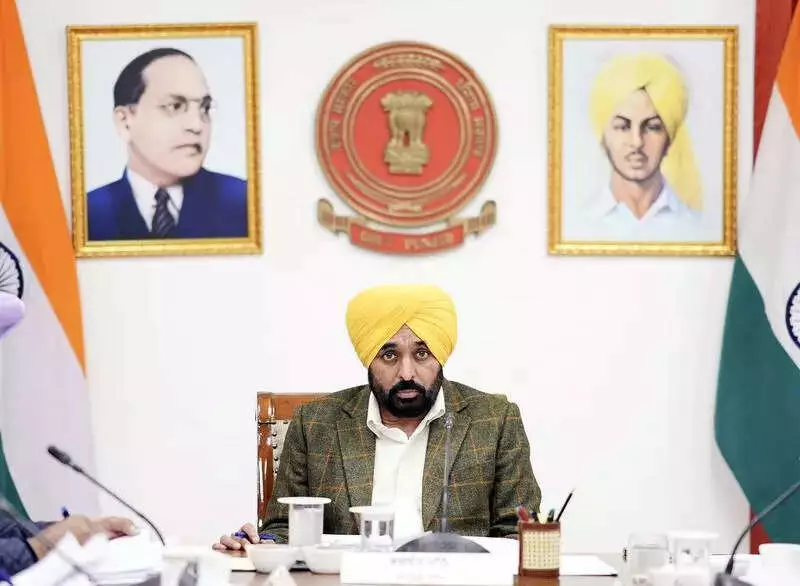
The Punjab Cabinet, in a significant meeting held on Friday, announced a series of major decisions aimed at boosting healthcare, providing relief to plot allottees, rationalizing property prices, and facilitating infrastructure development. The key approvals include the allotment of land for a minority medical college in Lehragaga, an extension of an amnesty scheme, a reduction in property rates for GMADA, and permission for desilting the Sutlej river.
New Minority Medical College for Lehragaga
The Cabinet approved the allotment of 19 acres of land in Lehragaga to the Janhit Society for establishing a minority medical college and hospital by the Jain community. The land belongs to the now non-functional Baba Hira Singh Bhatthal Institute of Engineering and Technology and will be given on a nominal lease rent.
The admission process, seat allocation, and fee structure for the new institution will follow existing government guidelines. According to the Cabinet decision, the trust must start hospital operations at the earliest and within a five-year period from signing the Memorandum of Understanding (MoU).

Initially, the medical college must be operationalized with a hospital of at least 220 beds and an intake capacity of 50 MBBS seats. Furthermore, it must be expanded within eight years of the MoU to a facility with no less than 400 beds and 100 MBBS seats.
The Baba Hira Singh Bhatthal Institute, originally a government polytechnic founded in 1995 and upgraded to an autonomous engineering college in 2005, faced financial difficulties and stopped admissions in 2020.
Relief for Plot Allottees and GMADA Price Rationalization
In a move that offers relief to many, the Cabinet approved the extension of the Amnesty Policy 2025 for allottees of plots under various schemes of the housing and urban development department. This extension allows defaulters one more chance to apply under the policy before the cut-off date of March 31, 2026.
Eligible allottees can deposit the required amount within three months of approval from the concerned Special Development Authority. Interested parties must submit their application before the March 2026 deadline.
In another crucial decision for the real estate sector, the Cabinet gave a green signal to rationalize and reduce the prices of properties under the Greater Mohali Area Development Authority (GMADA). This follows a report submitted by independent evaluators.
Finance Minister Harpal Singh Cheema stated that GMADA property rates will be reduced by nearly 22.50% to ensure the sites are sold. The government has amended guidelines for e-auctions to determine reserve prices for residential, commercial, institutional, and industrial plots.
For future valuations, development authorities will appoint three independent valuers empanelled by nationalised banks and the Income Tax Department. For sites unsold in two or more previous auctions, the average rate from these valuers will be considered for setting the reserve price, subject to competent authority approval. These rates will be valid for one calendar year.
Approvals for Sutlej Desilting and Staff Adjustment
The Cabinet also granted approval to the National Highways Authority of India (NHAI) or its agencies to carry out desilting in the Sutlej river. The desilted earth will be provided at a rate of Rs 3 per cubic foot, matching the price of a previous contract at Siswan Dam, for use in road projects like the Ludhiana to Ropar stretch.
This concessional rate will be available to NHAI only until June 30, 2026. The Cabinet also granted an exemption from certain provisions of the Punjab Transparency in Public Procurement Act 2019 for this project.
Additionally, the Cabinet approved the adjustment of staff members from the defunct Baba Hira Singh Bhatthal Institute of Engineering and Technology. These employees will be accommodated against vacant posts in the Department of Technical Education and Industrial Training and in autonomous institutions, on a deputation basis.

These wide-ranging decisions by the Punjab Cabinet are expected to have a substantial impact on healthcare accessibility, provide financial relief to citizens, stimulate the real estate market in Mohali, and support critical national infrastructure projects in the state.