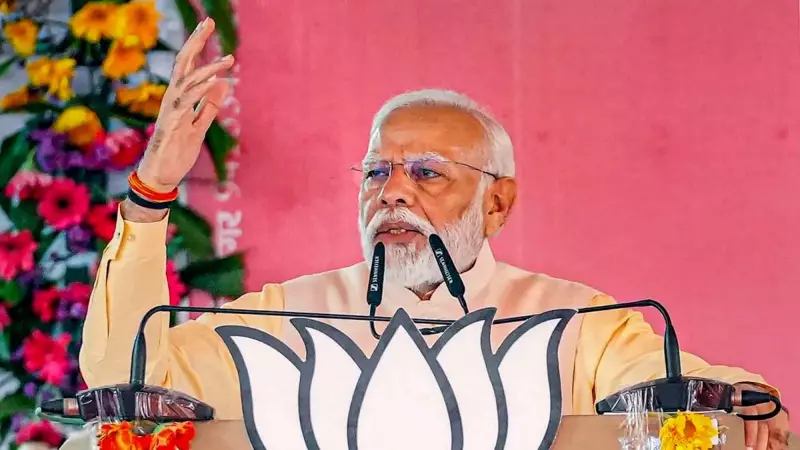
Prime Minister Narendra Modi is scheduled to address a significant public gathering at Singur's Gopalnagar Mouza in West Bengal's Hooghly district on January 18, 2026. This visit, nearly two decades after Tata Motors relocated its Nano factory from the site, marks a pivotal moment in the state's political landscape. The rally is a key part of the Prime Minister's two-day trip to Bengal, which also includes a public meeting in Malda on January 17.
The Strategic Choice of Singur
A senior BJP leader emphasized that selecting Singur for the Prime Minister's address is a calculated political move. It aims to spotlight the party's commitment to industrial growth and contrast it with the alleged failures of the ruling Trinamool Congress (TMC) government. "The Prime Minister will send a strong message from Gopalnagar Mouza about industrial failure during the TMC tenure as well as the BJP's vision for reviving Bengal's industries if it comes to power," the leader stated.
Hooghly BJP president Gautam Chatterjee confirmed the finalization of the Singur location, noting that party officials have already visited the site. The choice is deeply symbolic, as Singur was the epicenter of a land acquisition protest in 2006 that ultimately reshaped Bengal's politics, ending the Left Front's 34-year rule and propelling Mamata Banerjee and the TMC to power in 2011.
BJP's Accusations: An "Industrial Graveyard"
The BJP has launched a sharp critique of Chief Minister Mamata Banerjee's administration, branding the state an "industrial graveyard." In a document titled "West Bengal Industrial Graveyard," released in December 2025, the party outlined three major failures:
- Industrial Annihilation: Systematic destruction of manufacturing and investor confidence.
- Fiscal Catastrophe: Reckless borrowing and mismanagement of public funds.
- Governance Failure: Pervasive corruption and diversion of central schemes.
The party's data claims the state's debt ballooned from Rs 2.07 lakh crore in 2011-12 to a projected Rs 7.71 lakh crore in 2025-26, a staggering 305% increase. Per capita debt allegedly rose from Rs 22,570 to Rs 76,766 in the same 14-year period.
Furthermore, the BJP alleges abysmal implementation of investment proposals from the Bengal Global Business Summit (BGBS), claiming only 3% of proposals have been realized. They state that despite securing proposals worth Rs 23.94 lakh crore and signing over 1,200 MoUs across eight BGBS editions, most projects remain invisible on the ground. The TMC government, however, has countered that work for investments worth Rs 13 lakh crore is underway from the Rs 19 lakh crore proposals received.
Singur's Enduring Political Legacy
The site of the upcoming rally holds profound historical weight. The Left Front government's plan to acquire farmland for the Tata Nano plant in 2006 triggered massive protests, led by then-opposition leader Mamata Banerjee. Her agitation against "forcible acquisition" galvanized public support, leading to Tata Motors' exit in October 2008 and the project's shift to Gujarat.
This movement became the springboard for the TMC's ascent. After coming to power, Banerjee's government returned the land to farmers, and the abandoned factory structures were demolished following a 2016 Supreme Court directive. "Singur had played a crucial role in the change in West Bengal politics... The Prime Minister's visit will also have a strong impact on the people," the senior BJP leader noted, acknowledging the site's symbolic potency.
As Prime Minister Modi prepares to take the stage in Singur, his speech is anticipated to frame the upcoming political battle in Bengal around narratives of development, governance, and economic revival, directly challenging the legacy of the very movement that defined the current ruling party's origin.