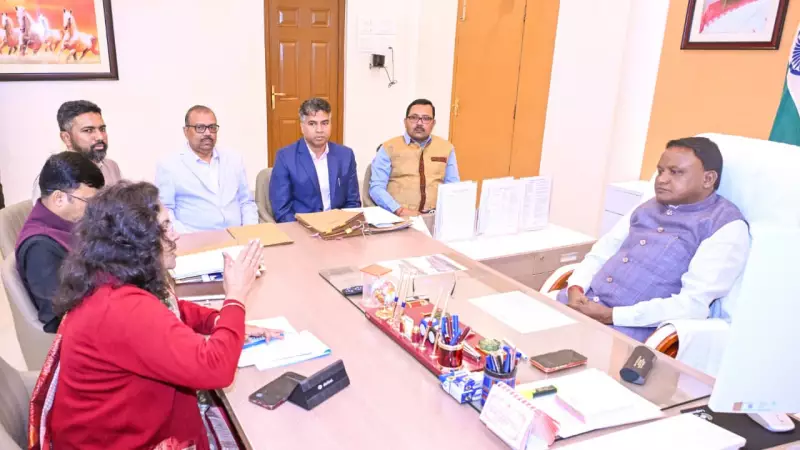
In a decisive move to kickstart the new year, Odisha Chief Minister Mohan Charan Majhi issued a comprehensive 15-point directive to the state's newly appointed Chief Secretary, Anu Garg, on New Year's Day, Thursday. The directive outlines an aggressive agenda to make the state administration more dynamic, transparent, and focused on the people.
Aligning Administration with Odisha's Ambitious Vision
The instructions are squarely aligned with the long-term goals of Odisha Vision 2036 and 2047. Chief Minister Majhi instructed the bureaucracy to prioritize the development of knowledge-driven industries and the services sector. A key focus is on fast-tracking clearances to enable rapid industrial growth across the state.
Majhi emphasized the urgency of action, stating that the government must work swiftly over the next two years to achieve the objectives laid out in the Vision Document. The ambitious plan aims to transform Odisha into a prosperous state with a $500-billion economy by 2036 and position it among India's top five developed states through a mixed-economy model.

Zero Tolerance and Cultural Identity at the Core
The chief minister mandated a policy of zero tolerance towards corruption. He instructed the administration to identify corrupt, inefficient, or irresponsible officials and take strict action against them. This action could include compulsory retirement under Article 311 of the Constitution and the Odisha Service Rules.
In a significant move to reinforce cultural identity, Majhi directed that all official work—including notices, announcements, and correspondence—must be conducted exclusively in the Odia language. This rule applies from the state Secretariat down to the block level, with non-compliance inviting disciplinary action.
Strengthening Governance and Public Grievance Redressal
The directive places strong emphasis on improving governance and public service delivery. Key measures include:
- Expediting processes linked to industrial development at the district level.
- Filling all vacant government posts within a strict two-year timeline.
- Deploying skilled and efficient officers in key roles to improve performance.
- Making field visits mandatory for officials to assess ground realities, with reports from these visits impacting their performance evaluations.
- Strengthening the Bhubaneswar-based Nabakrushna Choudhury Centre for Development Studies as a centre of excellence for research and policy assessment.
Majhi also ordered a continuous review and evaluation of all government schemes to ensure their effectiveness. On public grievance redressal, officers at all levels—from the Secretariat to district, block, and tehsil offices—were directed to hear public complaints seriously and resolve them promptly. The use of social-media-based mechanisms for this purpose was also encouraged.
This 15-point charter is widely seen as the chief minister's robust attempt to energize and overhaul the administrative machinery at the beginning of the new year, setting a clear tone for a proactive and accountable government.