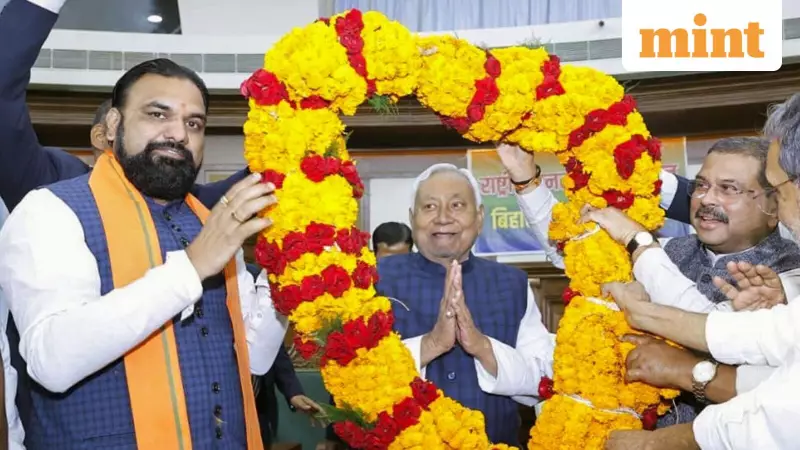
In a landmark political event, Janata Dal (United) leader Nitish Kumar is poised to create history by taking oath as Bihar's Chief Minister for an unprecedented tenth time. The grand ceremony is scheduled for November 20 at Patna's iconic Gandhi Maidan, marking another chapter in his remarkable political career spanning over two decades.
A Political Journey Like No Other
The 74-year-old leader first assumed the chief ministerial office in 2000, though his initial tenure lasted merely eight days before the government collapsed. His political fortunes changed dramatically in 2005 when he began a sustained period of leadership that would establish him as Bihar's most enduring chief minister.
Nitish Kumar's political resilience has been tested multiple times, most notably in 2014 when he resigned following JD(U)'s disappointing performance in the Lok Sabha elections. However, his resignation proved temporary, as he was soon sworn in again, demonstrating his indispensable role in Bihar's political landscape.
His most recent oath-taking occurred in January 2024, when he and his party realigned with the Bharatiya Janata Party (BJP)-led National Democratic Alliance (NDA), a move that continues to shape Bihar's current political dynamics.
India's Longest-Serving Chief Ministers
While Nitish Kumar's achievement is remarkable, he stands among several political stalwarts who have demonstrated exceptional longevity in Indian state politics.
Pawan Kumar Chamling holds the distinction of being India's longest-serving chief minister, having led Sikkim for an impressive 24 years and 165 days between December 12, 1994, and May 26, 2019. His party, the Sikkim Democratic Front, secured five consecutive terms under his leadership.
Naveen Patnaik of the Biju Janata Dal governed Odisha for exactly 24 years from March 5, 2000, to June 12, 2024. His remarkable tenure concluded only after the BJP achieved a decisive majority in the 2024 Odisha elections.
West Bengal's Jyoti Basu, the communist leader who declined the opportunity to become India's Prime Minister, served as chief minister for 23 years from June 21, 1977, to November 5, 2000. He was among the founding members of the Communist Party of India.
Other Notable Long-Serving Chief Ministers
Gegong Apang of Arunachal Pradesh accumulated nearly 23 years in office across two separate stints, while Lal Thanhawla served five terms as Mizoram's chief minister totaling 22 years.
Himachal Pradesh's Virbhadra Singh, a Congress veteran, served multiple terms totaling 21 years, establishing himself as the state's longest-serving chief minister.
Tripura's Manik Sarkar completed four consecutive terms from 1998 to 2018, serving for 19 years as one of India's most prominent Left leaders.
Among these political giants, Nitish Kumar has served as Bihar's chief minister for approximately 19 years since 2005, with only a brief interruption in 2014. His upcoming tenth oath-taking ceremony solidifies his position as one of India's most enduring and significant regional leaders.
The list of long-serving chief ministers also includes Tamil Nadu's M Karunanidhi (18 years) and Punjab's Parkash Singh Badal (18 years), both of whom left indelible marks on their respective states' political landscapes.
The Significance of Political Longevity
The ability of these leaders to maintain power for extended periods speaks volumes about their political acumen, connection with voters, and capacity for governance. Nitish Kumar's upcoming tenth term represents not just a personal achievement but also reflects the evolving nature of Indian democracy and regional politics.
As political observers watch today's ceremony in Patna, they recognize that they are witnessing history in the making—the consolidation of a political legacy that will be studied and discussed for years to come in Indian political circles.