Nagpur Civic Polls Deliver Crushing Blow to Independent Candidates
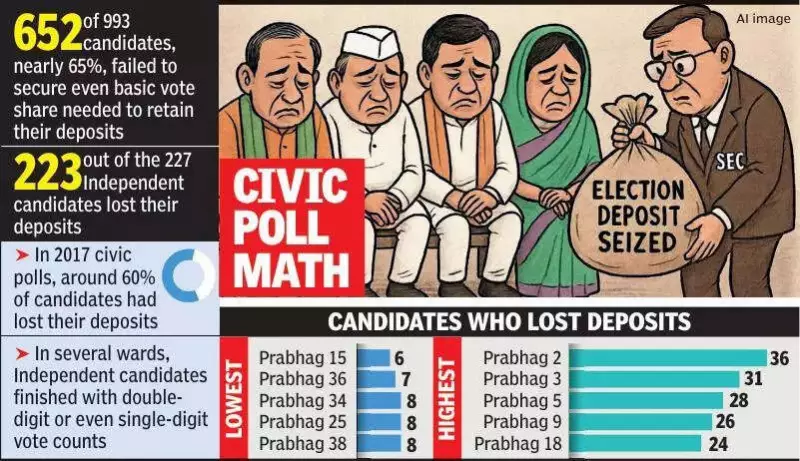
The results from Nagpur's recent civic elections have dealt a devastating blow to non-party players, particularly independent candidates. A staggering 652 out of 993 contestants failed to secure even the basic vote share required to retain their election deposits. This represents nearly 65% of all candidates who faced rejection from voters.
Independents Face Near-Total Wipeout
The situation proved especially dire for independent candidates. Election data reveals that 223 out of 227 independent contestants lost their deposits. This marks a significant increase from the 2017 civic polls, where approximately 60% of candidates faced similar forfeitures.
Election rules clearly state that candidates must secure at least one-sixth of the votes polled in their ward to avoid deposit forfeiture. This threshold equals 16.67% of total votes cast. A detailed ward-by-ward analysis demonstrates that voter support decisively consolidated around major political parties.

Voters Rally Behind Established Parties
Nagpur's electorate showed clear preference for organized political machinery. Voters overwhelmingly backed the Bharatiya Janata Party (BJP), the Indian National Congress, and the All India Majlis-e-Ittehadul Muslimeen (AIMIM). This consolidation left independent candidates virtually invisible across the city's electoral landscape.
Despite contesting seats throughout Nagpur, not a single independent candidate managed to cross the minimum vote threshold. Many independents finished with shockingly low vote counts. Several wards saw independent candidates receive only double-digit or even single-digit votes, highlighting the extent of voter rejection.
Exceptions Prove the Rule
A handful of independent candidates managed to make some impact, though none secured victory. Ravindra Dolas emerged as a notable exception, polling 6,895 votes to become second runner-up in Prabhag 21B. BJP candidate Rambhau Ambulkar won that ward with 11,584 votes.
Other independents who showed some presence included Dhiraj Chavan in Prabhag 18A, Puja Manmode in Prabhag 31D, and Kamlesh Chaudhari in Prabhag 12D. However, these performances remained isolated exceptions rather than indicating broader success.
Symbolic Campaigns and Financial Losses
The election revealed numerous campaigns that appeared more symbolic than competitive. As many as 40 candidates, predominantly independents, secured only single-digit votes. This suggests many contestants entered the fray without realistic expectations of winning.
The financial implications proved significant for unsuccessful candidates. Women candidates and those from Scheduled Castes, Scheduled Tribes, and Other Backward Classes paid a concessional deposit of 2,500 rupees. Open-category candidates faced a higher deposit of 5,000 rupees. The widespread forfeiture of these deposits represents substantial collective financial loss.
Political Analysis Points to Clear Trends
Political analysts interpret these results as clear evidence of changing voter behavior. Urban voters in Nagpur appear to be moving decisively toward party-centric politics. Voters increasingly prioritize professional and organized electoral candidature over individual identity.
The loss of deposits highlights a collective failure by independent candidates to connect with Nagpur's electorate. Even political visibility offered no protection in several notable cases. BJP rebel Sunil Agrawal lost his deposit in Prabhag 14D despite receiving 3,875 votes, falling short of the 4,272-vote threshold.
Nationalist Congress Party leader Dilip Pankule faced similar rejection in Prabhag 36D. He secured only 1,306 votes against a minimum requirement of 5,602 votes.
Ward Dynamics Favor Major Parties
Prabhags with heavy multi-cornered contests particularly favored established political parties. Prabhag 2 featured 36 candidates, Prabhag 3 had 31 contestants, Prabhag 5 included 28 candidates, Prabhag 9 contained 26 contestants, and Prabhag 18 hosted 24 candidates. These crowded fields left little room for independents to emerge as serious challengers.

Even prabhags with fewer candidates failed to produce independent winners. Prabhag 15 featured only 6 candidates, while Prabhag 36 had just 7 contestants. Yet independents still couldn't break through in these less crowded races.
The Nagpur civic election results send a strong message about contemporary urban politics. Voters clearly prefer candidates backed by organized political parties with established track records and professional campaign machinery.