Nagpur's Mayoral Election Faces Procedural Hurdles as Political Activity Intensifies
The election for Nagpur's mayor and deputy mayor positions continues to be delayed, with the civic administration yet to announce a formal schedule despite escalating political activity across party lines. This procedural standoff has created uncertainty in the city's municipal governance framework.
Opposition Participation Key to Election Process
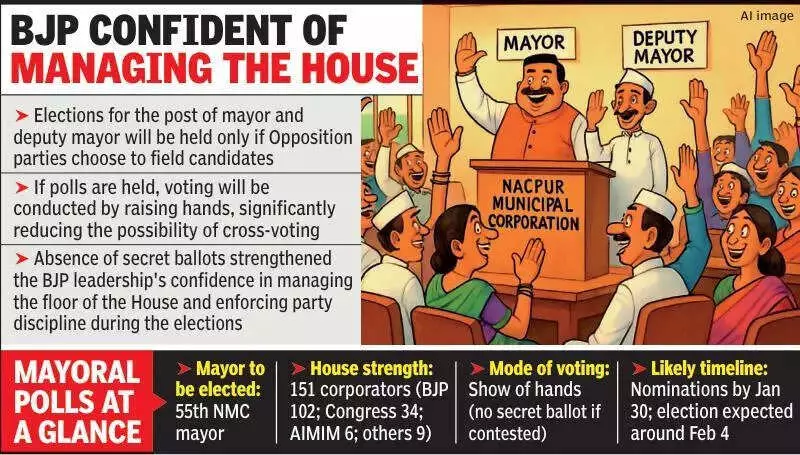
Officials have clarified that the election will proceed only if opposition parties such as Congress or AIMIM decide to field candidates against the BJP's nominees. In such a scenario, voting will be conducted through a show of hands during the general body meeting, with no provision for a secret ballot. This transparent method ensures public accountability but also highlights the political tensions surrounding the process.
According to officials familiar with the election procedures, if no rival candidates are nominated against the BJP's official candidates, the mayor and deputy mayor could be declared elected unopposed. However, sources indicate that unanimity appears unlikely despite the BJP's overwhelming numerical strength in the 151-member Nagpur Municipal Corporation House.

BJP's Commanding Majority Versus Opposition Strategy
The BJP holds a commanding majority with 102 corporators, far exceeding the halfway mark of 76 required for control. Congress serves as the main opposition with 34 members, followed by AIMIM with 6 corporators. Other parties include the IUML with 4 members, Shiv Sena (UBT) with 2, Shiv Sena (Shinde) with 1, and NCP (Ajit) with 1 representative.
While the opposition lacks the numerical strength to influence the election outcome significantly, their participation ensures that the process transcends mere formality. For opposition parties, contesting the mayor and deputy mayor elections represents an opportunity to establish political presence in the new House rather than a realistic bid for power.
Statutory Requirements and Scheduling Complexities
The delay in finalizing the election date stems from statutory requirements under the Maharashtra Municipal Corporation Act. This legislation mandates that nominations for mayoral elections must be filed at least three working days before the polling date. With January 30 being discussed as a potential nomination day and intervening holidays limiting available working days, February 4 has emerged as the most feasible date for holding the election.
Officials noted that the withdrawal of candidates for both mayoral and deputy mayor polls will occur on the election day itself, adding another layer of procedural complexity to the process.
Political Consultations and Leadership Absence
Sources revealed that while the BJP city unit suggested tentative dates for the polls—particularly for nomination filings—the delay is largely attributed to the absence of Chief Minister Devendra Fadnavis. The CM was away attending the World Economic Forum meeting in Davos, Switzerland. Party leaders reportedly deferred finalizing the election schedule until Fadnavis's return, despite the BJP's clear majority in the NMC House.
For the BJP, this delay has extended internal consultations regarding its nominees, especially since the mayor's post is reserved for a woman from the open category. This reservation adds another dimension to the party's candidate selection process, requiring careful consideration of both political and demographic factors.
The ongoing uncertainty surrounding Nagpur's mayoral election reflects broader dynamics in municipal politics, where procedural formalities intersect with strategic political calculations. As parties position themselves for the upcoming electoral contest, Nagpur residents await clarity on when their city's leadership will be formally established through democratic processes.