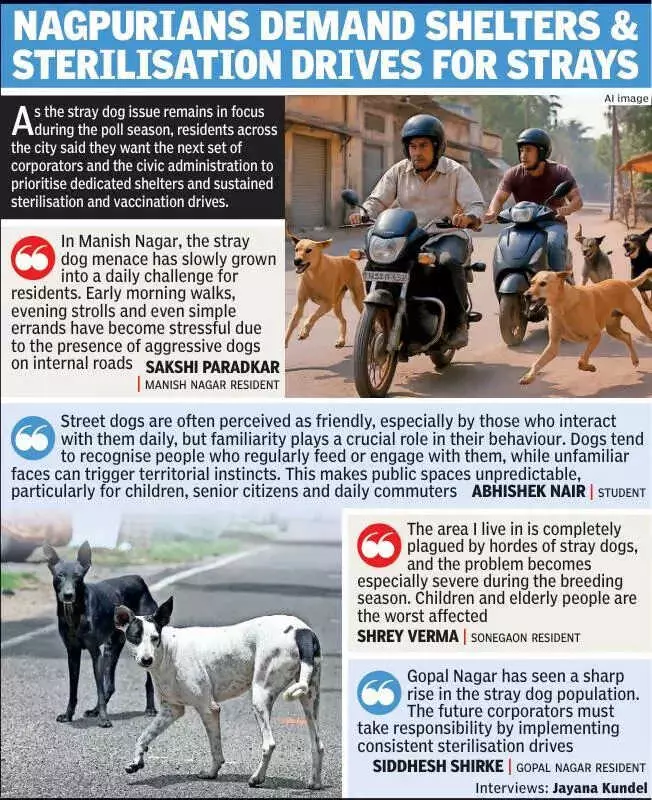
The growing threat of stray dog attacks and the fear of roaming canine packs on residential streets have sharply risen to become a defining issue in the ongoing Nagpur Municipal Corporation (NMC) elections. With citizens expressing deep concern over safety, candidates from both the Bharatiya Janata Party (BJP) and the Indian National Congress are now prominently promising to resolve this persistent civic problem.
Political Promises Take Center Stage
Union Minister Nitin Gadkari, while campaigning in east Nagpur on Friday, highlighted the stray dog menace as one of the biggest complaints from residents. He linked it directly to the local priorities for his panel. Gadkari assured voters that all four corporators from his panel would prioritize resolving the issue, noting that the area faces a particularly severe problem.
The BJP's official poll manifesto, released on Sunday, dedicated a section to tackling the stray dog crisis. The party pledged a long-term resolution through a multi-pronged strategy. This includes encouraging pet adoption, identifying designated feeding spots in compliance with court directions, creating adequate shelter facilities, and intensifying population-control measures like sterilization.

Congress leaders, in turn, have blamed the ruling BJP for neglecting the issue and compromising public safety. They pointed out that in several neighborhoods, residents have become fearful of stepping out during early mornings or late evenings due to the threat of dog packs.
Ground Reality: A Crisis of Safety and Welfare
Vinod Patil, the Congress candidate from Ward 37, framed the issue as a dual challenge of animal welfare and civic safety. He called it a clear failure of the Nagpur Municipal Corporation. Patil reported a rise in incidents of dogs biting both people and other dogs, with small children among the victims. He linked repeated episodes in his area to unregulated public feeding of strays, which has triggered resident protests.
Ashwini Jichkar, the BJP candidate from the same Ward 37, emphasized that the response must move beyond mere complaints. She called for concrete action backed by proper infrastructure and planned drives. "If we come to power, we will definitely implement these measures," Jichkar stated. She clarified that the issue is directly linked to on-ground citizen problems and requires priority attention in severely affected areas through shelters, rehabilitation centers, and systematic sterilization.
Why the Issue Gained Electoral Salience
Congress candidate Prashant Kapse noted that attacks on young children over the past year transformed the problem into a high-priority civic issue. He cited areas around the mutton market in his prabhag as having a huge stray dog problem and criticized the NMC's previous sterilization drives for failing to deliver results.
BJP candidate Nidhi Telgote provided a detailed analysis, explaining that the issue existed for years but crossed a critical tipping point after the COVID-19 pandemic. She pointed out that stray populations increased post-Covid while sterilization and regulation efforts slowed down, leading to the formation of large, intimidating packs instead of isolated animals.
Telgote further elaborated that increased urban density and daily human-dog interactions have resulted in more frequent bite incidents, particularly affecting vulnerable groups like children, senior citizens, and frontline workers. The amplification of these incidents on social media, coupled with courts beginning to treat it as a public safety concern, pushed the issue into the mainstream. Citizens across ideological lines started demanding balanced solutions that ensure both human safety and animal welfare, inevitably making it a potent electoral issue that has drawn attention from senior leadership.