Telangana ministers have strongly defended the state's policy to shift industrial units from within the Outer Ring Road (ORR) to the outskirts, asserting it will transform Hyderabad into a more liveable and environmentally sustainable global metropolis. The defence came during a legislative debate on the Hyderabad Industrial Transfer (HILT) Policy and the Telangana Rising 2047 vision.
Ministers Champion Voluntary Relocation for a Greener City
Irrigation Minister and a key member of the HILT Policy sub-committee, N Uttam Kumar Reddy, emphasised the policy's long-term benefits. He stated that the initiative, developed with significant input from the current government, is designed to improve Hyderabad's environment and elevate its status on the world stage. "This policy is good for Hyderabad and Telangana. We played a key role in developing it, and I genuinely consider it the best. It will improve the environment and make Hyderabad a global metropolitan city," Reddy affirmed.
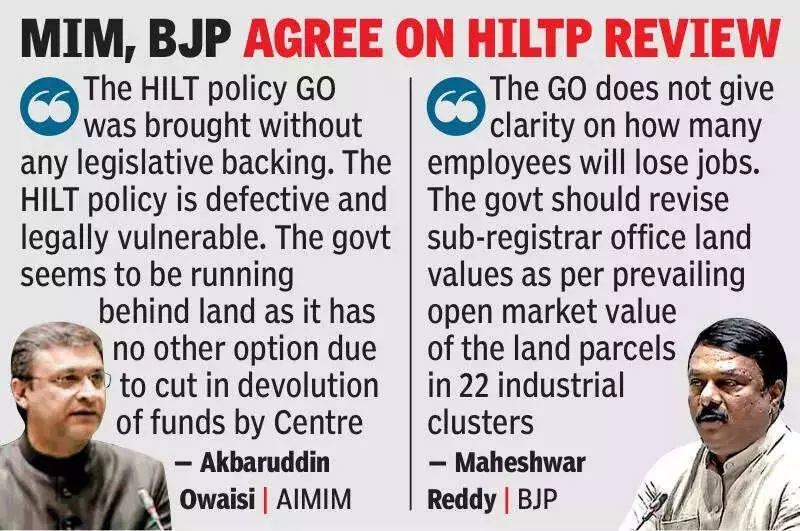
Addressing opposition concerns, Minister Reddy clarified that the HILT Policy will remain voluntary, not mandatory. He challenged critics from the BJP and BRS, asking, "Do you want us to shift polluting industries outside the ORR or not? If your suggestion is to make it mandatory, please state it openly." He also expressed disappointment over what he termed "harsh and unsubstantiated criticism" from rivals who alleged financial irregularities in the process.

Addressing Urban Sprawl and Practical Challenges
Tourism Minister Jupally Krishna Rao provided context for the policy, noting that many industrial zones, like Azamabad, were originally established in open areas but are now encircled by residential colonies. This co-location has led to significant environmental and livability issues for citizens.
Minister Uttam Kumar Reddy outlined specific policy parameters, stating that only lands with complete ownership would be considered for transfer, excluding leasehold properties. He acknowledged practical hurdles, pointing out that industries currently operating at full capacity have little incentive to relocate without support. "We want to incentivise the affected industries to move out of the city," he explained, highlighting the government's intent to provide necessary facilitation.
Broad Support and the Path Forward
The policy has garnered support beyond the treasury benches. CPI member Kunamneni Sambasiva Rao also extended his backing to the proposed scheme, indicating broader political consensus on the need for such an urban rejuvenation measure.
The ministers framed the HILT Policy as a solution to decades-old problems where mixed-use areas have become "uninhabitable." The envisioned outcome is a dual benefit: hundreds of industries gain opportunities for modernised operations in designated zones, while Hyderabad's residents enjoy better environmental conditions, reduced pollution, and enhanced quality of life as the city marches towards its 2047 development goals.