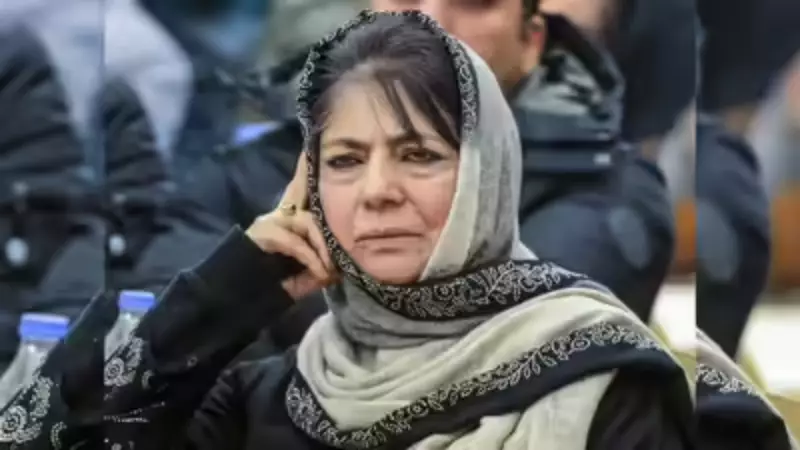
In a decision with significant political and social ramifications, the National Medical Commission (NMC) has withdrawn permission for the Shri Mata Vaishno Devi Institute of Medical Excellence (SMVDIME) in Reasi to conduct its MBBS program. The move has ignited a fierce debate, with former Jammu and Kashmir chief minister Mehbooba Mufti warning it could empower communal forces nationwide to exclude Kashmiri Muslim students from educational spaces.
A Decision with Far-Reaching Consequences
Addressing a press conference at the Peoples Democratic Party (PDP) headquarters on Friday, Mehbooba Mufti described the NMC's order as one with far-reaching consequences. She expressed concern that it sets a dangerous precedent, potentially emboldening groups across India to push for the exclusion of Kashmiri Muslims from academic institutions. "The larger question is that Kashmiri Muslim students didn't get space in their own state. If this is their fate in J&K, how will they be treated in other parts of the country?" she questioned.
Mehbooba also pointedly criticized the role of Jammu and Kashmir's elected government. She noted that just hours before the NMC's announcement, Chief Minister Omar Abdullah had publicly stated the medical college should be shut down. "Was there some understanding or discussion going on that whatever he said happened? The chief minister should have stood up against the decision to close the college," she asserted. She alleged the decision was taken under pressure specifically to remove Kashmiri Muslims from the institution.

The NMC's Rationale and Political Backlash
The National Medical Commission officially withdrew its Letter of Permission for the MBBS course at SMVDIME on Tuesday. The regulator cited major deficiencies in faculty strength, clinical material, and infrastructure as the reasons for its action. The permission, initially granted on September 8, 2025, was for 50 seats for the 2025-26 academic year. The NMC stated that students already admitted during counselling would be accommodated in other government medical colleges.
This explanation has been met with skepticism from multiple political quarters. They have raised a critical question: if the institute failed to meet minimum standards, how was it granted permission merely four months prior? The controversy has its roots in November of last year when the admission list for the 50 seats showed 42 seats going to Muslim students, predominantly from Kashmir, and only seven to Hindu students from Jammu.
This outcome triggered protests by the Jammu-based Shri Mata Vaishno Devi Sangharsh Samiti, a coalition of about 60 religious and civil society groups. The protestors argued that an institution funded by the Shri Mata Vaishno Devi Shrine Board should prioritize Hindu students. The Bharatiya Janata Party (BJP) later supported the agitation, with its leaders appealing to Lieutenant Governor Manoj Sinha, who also chairs the shrine board. They sought a review of the admission policy, suggesting "faith" should be a criterion for admission in a college run on Hindu donations.
Leadership Responses and Unanswered Questions
Chief Minister Omar Abdullah offered a strong reaction on Thursday. He expressed dismay that while people across India strive to establish medical colleges, some in Jammu were celebrating the closure of one following protests on religious grounds. He redirected the inquiry toward Shri Mata Vaishno Devi University, which operates SMVDIME, asking why the NMC revoked the permission. "Who is the chancellor of the university? You should ask him too," Omar told reporters. The chancellor of the university is Lieutenant Governor Manoj Sinha.
The situation leaves several unresolved issues. The timing of the NMC's reversal, following intense political and social pressure related to the student demographics, has led to allegations of the decision being influenced by non-academic factors. The future of medical education in the region and the assurance of merit-based, non-discriminatory access for all students remain central concerns emerging from this contentious development.