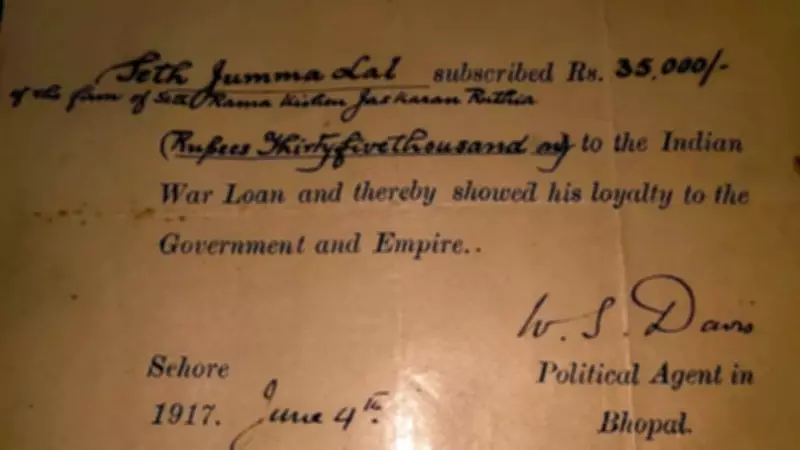
Grandson Pursues Century-Old British Debt Claim in Madhya Pradesh
A remarkable financial claim spanning over a century has emerged from Madhya Pradesh, where a man is actively investigating legal avenues to recover a loan his grandfather extended to the British government during the colonial era. The original sum of Rs 35,000 was provided in 1917, and the family asserts that when adjusted for inflation and compounded interest over more than 100 years, the amount would now be valued at several crores of rupees in today's economy.
Historical Context and Family Legacy
The loan dates back to World War I, a period when the British Empire was heavily involved in global conflicts and often sought financial support from its colonies, including India. According to the family's account, the grandfather, whose identity has not been fully disclosed, loaned the substantial sum to the British authorities, possibly as part of war efforts or local administrative needs. This transaction represents a tangible piece of colonial history, highlighting the economic interactions between Indian citizens and the ruling British regime.
The current descendant, residing in Madhya Pradesh, has taken up the cause to seek repayment, emphasizing the moral and financial obligation owed by the British government. He is reportedly consulting with legal experts and historians to build a robust case, which may involve international law or diplomatic channels given the cross-border nature of the claim.

Financial Implications and Inflation Adjustment
The family's calculation of the loan's present value is based on inflation adjustments and interest accrual over the decades. Economists note that Rs 35,000 in 1917 was a significant amount, equivalent to a large fortune by the standards of that time. When factoring in India's historical inflation rates and potential interest, the sum could indeed escalate to crores, though exact figures depend on the methodology used for calculation.
This case raises intriguing questions about historical debts and their modern-day repercussions. If successful, it could set a precedent for other similar claims from the colonial period, potentially involving numerous families across India who may have extended loans or provided resources to the British.
Legal and Diplomatic Challenges
Pursuing such a claim involves navigating complex legal landscapes. Key challenges include:
- Statute of Limitations: Determining whether legal time limits for debt recovery apply to century-old transactions.
- Jurisdictional Issues: Addressing which country's laws govern the claim—Indian, British, or international.
- Documentation: Proving the existence and terms of the loan with historical records, which may be scarce or incomplete.
- Diplomatic Relations: Engaging with the British government through diplomatic means, which could involve bilateral discussions or international arbitration.
The man from Madhya Pradesh remains hopeful, citing family oral histories and any preserved documents as evidence. His efforts have garnered attention locally, sparking discussions about colonial reparations and historical accountability.
Broader Implications for Colonial History
This story transcends a mere financial dispute; it touches on the legacy of British colonialism in India. Many scholars argue that the economic exploitation during that era left lasting impacts, and claims like this one bring those issues to the forefront. If the family succeeds, it could encourage more research into similar cases, potentially leading to a broader reassessment of colonial debts and their settlement.
As the investigation continues, the outcome will be closely watched by historians, legal experts, and the public alike. Whether the British government responds or the claim progresses through legal systems, this case highlights the enduring connections between past actions and present-day justice in a globalized world.