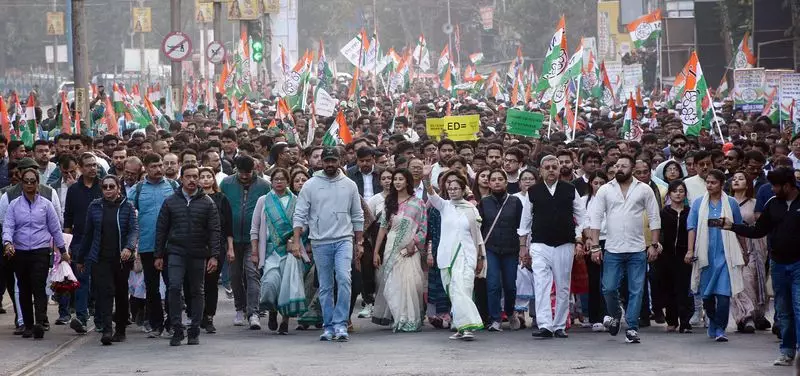
In a stunning display of political theatre, West Bengal Chief Minister Mamata Banerjee masterfully converted a law enforcement action into a massive public rally, showcasing her defiance and grassroots strength. The incident unfolded on January 5, when officials from the Enforcement Directorate (ED) arrived at the residence of state minister Jyotipriya Mallick to conduct searches.
From Raid to Rally: A Day of High Drama
The scene at Minister Jyotipriya Mallick's home was tense as ED officials began their operations early in the day. The probe was reportedly linked to an alleged ration distribution scam. However, the narrative shifted dramatically when Chief Minister Mamata Banerjee decided to make a personal visit to the site.
Banerjee did not go alone. Her arrival sparked a spontaneous gathering, which rapidly swelled into a large crowd of Trinamool Congress (TMC) supporters and workers. What began as a search operation soon transformed into a vibrant political demonstration, with the Chief Minister at its center, directly confronting the central agency's actions.
The timing was significant, occurring just ahead of the crucial 2024 Lok Sabha elections. Banerjee used the platform to deliver a fiery speech, accusing the Bharatiya Janata Party (BJP)-led central government of misusing central agencies like the ED to target and harass political opponents. She framed the raid not as a legitimate investigation, but as a politically motivated attack on her party and government.
A Strategic Masterstroke in Political Messaging
Analysts view Banerjee's move as a calculated and strategic response. By physically placing herself at the raid site, she achieved several objectives simultaneously. First, she demonstrated solidarity with her minister, reinforcing loyalty within her party ranks. Second, she seized control of the media narrative, ensuring the story was about her defiance and the alleged political vendetta, rather than the specifics of the corruption probe.
Third, and perhaps most importantly, she mobilized her party cadre and sympathizers, presenting a unified and combative front. The images of a massive rally forming in response to an ED raid served as a powerful visual symbol of her popular support and resilience. This public spectacle effectively turned a potential moment of vulnerability into a show of formidable strength.
The event highlighted the ongoing, bitter tussle between the TMC government in West Bengal and the BJP-led central government. Banerjee has consistently positioned herself as a leading figure in the opposition's fight against the BJP, and this incident provided a perfect stage to reinforce that image.
Broader Implications for Indian Federal Politics
The fallout from this event extends beyond a single raid or rally. It underscores the deepening fault lines in India's federal structure and the increasingly contentious relationship between the Centre and opposition-ruled states. The use of central investigative agencies has become a major flashpoint in this conflict.
Banerjee's successful orchestration of the rally sends a clear message to her political adversaries and allies alike. It demonstrates her ability to command the streets and dominate the news cycle, a crucial skill in the high-stakes game of Indian politics. The incident is likely to be referenced repeatedly in the coming election campaign, serving as a cornerstone of the TMC's narrative of being a victim of central overreach and a champion of Bengal's pride.
As the 2024 elections draw nearer, such confrontations are expected to intensify. Mamata Banerjee's transformation of a January 5 ED raid into a roaring political rally will be remembered as a textbook example of turning a defensive situation into an offensive political opportunity. It reaffirms her reputation as a street-smart politician with an unparalleled ability to connect with her base and set the agenda on her own terms.