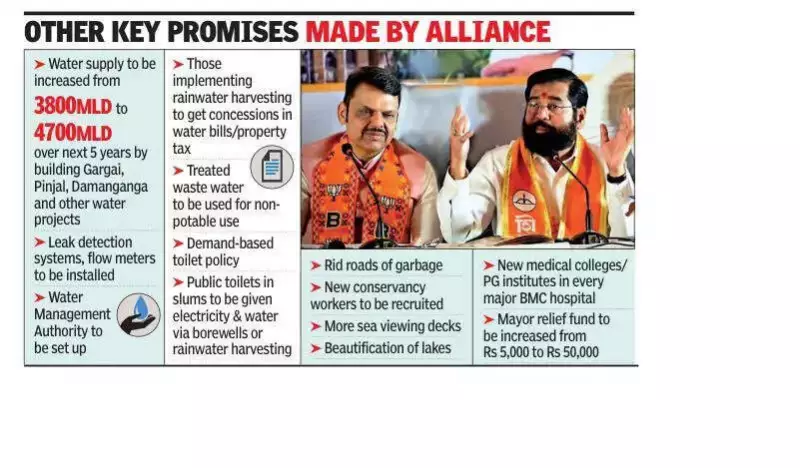
With just four days remaining for the high-stakes Brihanmumbai Municipal Corporation (BMC) elections, Chief Minister Devendra Fadnavis unveiled the ruling Mahayuti alliance's comprehensive manifesto on Sunday. The document lays out an ambitious roadmap for Mumbai's development, featuring significant financial concessions for women, a crackdown on illegal immigration using artificial intelligence, and major infrastructure overhauls.
Key Promises: Women's Welfare and Security Measures
The manifesto makes a major push for women's empowerment and urban security. It promises a 50% concession in fares for women traveling on BEST buses, a move aimed at easing the financial burden on daily commuters. Furthermore, women entrepreneurs will have access to interest-free loans of up to Rs 5 lakh for micro-enterprises, funded directly from BMC resources.
On the security front, the alliance plans to deploy technology for a contentious issue. An AI-based tool, to be developed by IIT Bombay, will be introduced within a few months to identify illegal Bangladeshi immigrants. The manifesto alleges that many such individuals enter via West Bengal with forged documents before arriving in Mumbai. This AI system will also be tasked with developing flood mitigation strategies for the monsoon season.

Infrastructure, Environment, and "Original Mumbaikar" Focus
The vision document outlines sweeping plans for the city's physical and environmental transformation. A significant pledge is a five-year freeze on the annual 8% increase in water tariffs. The alliance vows to double the BEST bus fleet from the current count to 10,000 vehicles, concretize all roads wider than 9 meters, and complete the ongoing Metro network by 2029.
Environmental promises are central, with a Rs 17,000-crore climate action plan for a circular economy, the establishment of an Environment Protection Authority, shutting all dumping grounds, commissioning sewage treatment plants within two years, and treating all rivers in up to six years. The manifesto also commits to freeing Mumbai from the "tanker mafia" and ensuring 24x7 water supply.
Deputy Chief Minister Eknath Shinde, present at the launch with Union Minister Ramdas Athawale, emphasized the goal to "bring back the original Mumbaikar" who had moved to distant suburbs like Virar and Karjat due to high costs. He cited the clearance for occupation certificates to 20,000 buildings and slum redevelopment projects at 17 locations, including Antop Hill and Govandi, as steps in this direction.
Holistic Development: Health, Livelihoods, and Housing
The manifesto extends its promises across various sectors. On healthcare, it plans to establish a Balasaheb Thackeray Medical College and add 2,000 beds to civic hospitals. For livelihoods, it promises to demarcate hawking zones, issue vending certificates, and introduce community parking solutions.
Skill development initiatives include the Mumbai Digital Sakhi program to train women in AI and coding, setting up a Marathi language lab, and providing internship programs for Gen Z. To boost employment, the establishment of Global Capability Centres will be encouraged.
Housing remains a critical focus, with the manifesto highlighting the redevelopment of MHADA layouts and SRA schemes. In a significant move, BMC conservancy workers will be granted ownership of their flats. CM Fadnavis stated that the manifesto's promises would be audited after five years, with a factsheet released to the public.
Taking a political dig at the Thackeray cousins, Uddhav Thackeray (Shiv Sena UBT) and Raj Thackeray (MNS), Shinde claimed their manifestos omitted any mention of late Shiv Sena founder Balasaheb Thackeray or Hindutva, pledging that his party would celebrate the founder's centenary with welfare measures.