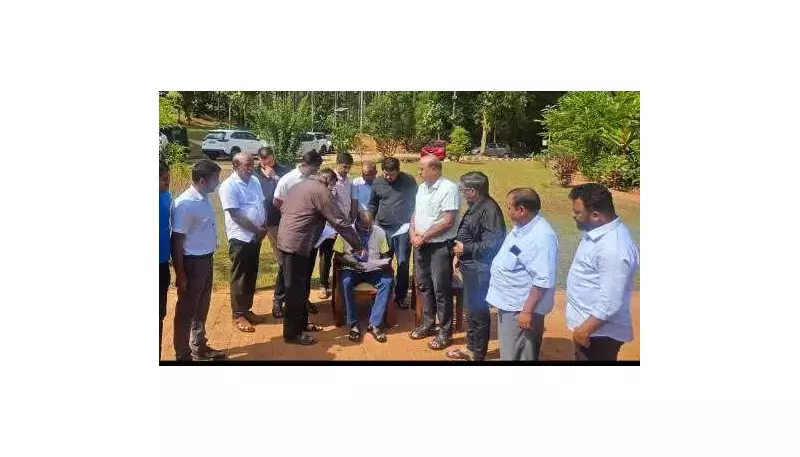
Union Minister for Heavy Industries and Steel, HD Kumaraswamy, has given a firm commitment to farmers in Karnataka's Malnad region, promising to develop permanent and scientific solutions to the severe agricultural crises they are facing. The assurance came during an interaction with the Malenadu Region Arecanut Growers Association in Chikkamagaluru on Wednesday.
A Region in Agricultural Distress
The minister acknowledged the dire situation of arecanut growers, who are battling a dual threat: devastating crop diseases and rampant wildlife conflict. The yellow leaf disease and leaf spot disease have crippled plantations, while wild animals regularly destroy crops, pushing farmers to the brink.
"I understand the problems of the farmers in this region," Kumaraswamy stated. He noted that the condition is so severe that many large-scale farmers have been forced to migrate elsewhere to sustain their livelihoods. The minister pledged, "I will discuss the matter with the concerned ministers and come up with suitable scientific permanent solutions."

The Core Issues: From Disease to Policy Failure
JD(S) MLC SL Bhojegowda emphasized that arecanut, a traditional and high-quality crop of Malnad, is the primary livelihood for countless families. He stressed that farmers' dignified survival requires immediate governmental attention.
Association President Talvane Prakash outlined a comprehensive list of challenges:
- Crop diseases like yellow leaf and leaf spot with no effective cure.
- Climate anomalies and unstable market prices.
- Problematic revenue and forest policies, including lack of clarity on eviction.
- Severe wildlife encroachment on farmland.
- The inability to cultivate alternative crops due to heavy annual rainfall (120-150 inches).
- An influx of poor-quality imported areca nut and black pepper, undermining local produce.
Catastrophic Crop Loss and Inactive Research
The ground reality is alarming. In parts of Sringeri and Koppa, plantations affected by yellow leaf disease are yielding a mere 5% of their potential, translating to a 95% crop loss. This has plunged farming communities into deep distress.
Compounding the problem is the perceived failure of research institutions. Despite substantial central funding to Shivamogga University and the Central Plantation Crops Research Institute (CPCRI), farmers say the response has been limited to ongoing research statements while plantations perish. The local research centres in Sringeri and Thirthahalli are reported to be inactive.
Furthermore, the financial burden of recommended fertilizers and initial treatments is too heavy for farmers whose income has been wiped out. Prakash also highlighted a critical funding gap: while the Union government sanctioned Rs 225.73 crore in 2022 and Rs 175 crore last year for managing these diseases, the state government has not released its matching share, preventing any relief from reaching the farmers.
The association has urgently appealed to authorities to curb the illegal import of areca nut and black pepper, which further depresses prices and hurts local growers. The ball is now in the court of the administration to translate Minister Kumaraswamy's assurances into concrete, on-ground action to save the Malnad region's agricultural heartland.