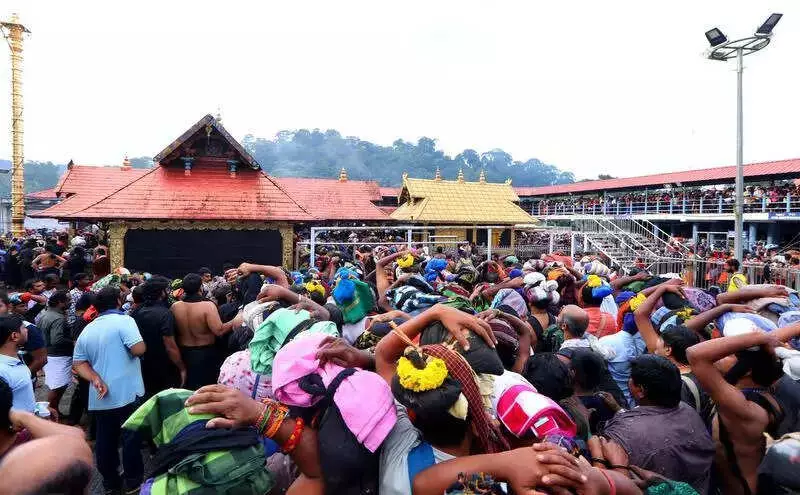
The Kerala State Road Transport Corporation (KSRTC) has formally challenged a critical report against its Sabarimala budget tourism initiative in the Kerala High Court. In a recently filed affidavit, the public transport utility asserted that the report submitted by the Sabarimala special commissioner was prepared under a misconception and without a proper understanding of the project's objectives and mechanics.
Controversy Over Pilgrim Assistance at Sannidhanam
The dispute centers around a proposal where KSRTC sought permission from the Travancore Devaswom Board (TDB) to deploy a staff member at Sabarimala Sannidhanam. This staffer's role would be to coordinate the budget tourism project and assist pilgrims. The TDB had initially accepted this request in principle.
However, the special commissioner later filed a report alleging that KSRTC's plan was an attempt to exploit pilgrims to boost its revenue and transform the holy site into a business center. The report urged the court to direct the TDB not to permit the scheme at Sannidhanam and to prevent KSRTC from bypassing established crowd-management protocols.

KSRTC's Clarification and Service Expansion Plans
In its defense, KSRTC, through its chief law officer P N Hena, provided detailed clarifications. The corporation outlined that its initiative is part of regular pilgrim transportation enhancements for the festival season. Key plans include:
- Operating special bus services connecting major temples like Guruvayur, Kodungallur, Chottanikkara, Vaikom, and Ettumanoor en route to Sabarimala.
- Deploying a staff member at Sannidhanam solely to assist pilgrims with:
- Speedy darshan (worship).
- Collection of prasadam from various designated counters.
- Smooth facilitation of their return journey.
The affidavit drew a direct comparison with existing private tour operators, who already offer comprehensive Sabarimala packages including Sannidhanam facilities like accommodation, special darshan, and prasadam collection. KSRTC aims to provide similar services in a budget-friendly manner, countering the high charges of private players.
Addressing Fare Structure and Ghat-Sector Charges
A significant portion of the affidavit was dedicated to refuting claims of financial exploitation. KSRTC clarified that the perception of it charging pilgrims higher fares is incorrect. It explained the legal fare structure:
Fares for stage carriages (buses) are fixed by the state government, and neither KSRTC nor private operators have any discretion in setting them. Furthermore, a government notification permits an additional levy of 25% as a ghat-sector fare for routes passing through ghat (mountainous) areas.
Since Sabarimala is located within a ghat sector, all stage carriage operators, including KSRTC, are legally entitled to collect this additional 25% charge. The corporation emphasized that this is a standard, legally mandated charge and not an arbitrary hike imposed by them.
The affidavit concludes KSRTC's stance that its project is designed for pilgrim welfare and convenience, operating within the established legal and regulatory framework, contrary to the special commissioner's allegations.