Kolkata's Engravers: The Unsung Harbingers of Election Season
Even before the first political banner is unfurled or the inaugural rally is announced, a distinct group of men in Kolkata's Lalbazar area can already sense the approaching elections. These individuals belong to a row of cramped, dust-filled workshops located just a few blocks away from the city's political nerve centers. Here, the rhythmic clink of hammer against granite serves as an unmistakable precursor to the democratic process that is about to unfold across West Bengal.
The Customary Pre-Election Facelift
With assembly elections approaching in a couple of months, Kolkata is undergoing its customary pre-poll facelift. Roads are being meticulously repaired, drains are being systematically cleared, and public parks are being carefully spruced up. At every development site across the city, a familiar trend has emerged, with plaques prominently announcing project details including the budget, location, and most significantly, the name of the elected representative responsible for the initiative.
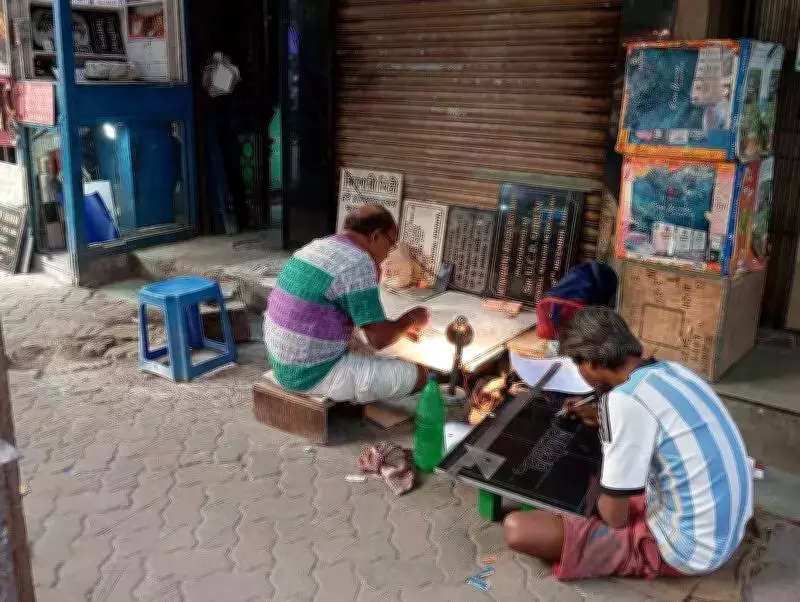
Inside these specialized workshops, skilled craftsmen are working overtime to meet the surge in demand before the Model Code of Conduct officially bars any such self-promotion by politicians. "Long before the general public becomes aware, we can sense the arrival of the election season," explains Bapi Das, a veteran engraver at RK Dey Engraving on Lalbazar Street who has been practicing his trade since the mid-1980s.

The Engraving Process and Political Dynamics
The engraving process begins three to four months before elections as orders start flowing in from political representatives. "Elected representatives are in a tremendous rush to showcase their work to their electorate," elaborates Prabhat Ghosh, a craftsman at a neighboring shop. "Orders surge dramatically during this period, and we have to set aside all other work to accommodate the political demand."
The engraving work is meticulous and requires careful attention to detail. Contractors and political aides frequently visit the workshops to scrutinize spellings and verify numerical figures. "They provide the exact content to be engraved. If even one zero is missing from the project amount, they make us redo the entire plaque," Ghosh noted with a touch of humor about the precision required for political commissions.
On particularly busy days, the engraving work spills onto the pavement outside the shops. Granite slabs are lined up in neat rows, waiting to be chiseled, polished, and eventually collected by political representatives. By noon, the engravers' shirts and hair are typically coated in a fine layer of dust from their labor-intensive work.
Political Patterns and Economic Impact
The plaques themselves follow a specific format: the politician's name and the sanctioned amount are etched in larger, more prominent fonts. There are no party symbols or political slogans included—only what engravers describe as "the language of development" that politicians hope will resonate with voters.
"It is usually the ruling party that places the maximum orders," revealed another experienced engraver who preferred to remain anonymous. "There are hardly any opposition MLAs, MPs, or councillors in and around the city currently placing similar orders." These workshops, situated just a stone's throw from Writers' Buildings—the former seat of power in West Bengal—have witnessed decades of political cycles and changing fortunes.
Interestingly, not all development projects progress as briskly as their plaques might suggest. At times, work stalls due to funding shortages or bureaucratic delays, but the engraved slab often remains at the site as a testament to promised development.
Economic Realities for Kolkata's Engravers
From an economic perspective, these plaques cost between Rs 1,200 and Rs 2,500 per piece depending on size and complexity. During peak election season, more than 500 plaques are produced each week across Lalbazar's workshops. Engravers report that four months of election-related work can surpass their usual monthly earnings from regular commissions.

Then there are particularly lucrative years that engravers describe as "double bonanza" periods—when two elections occur within the same year. The year 2021 presented such an opportunity when Kolkata Municipal Corporation elections followed just a few months after the state assembly elections.
"This year too we might witness two elections," said Das with optimistic anticipation. "Amra du poisha beshi pabo—we would earn a little extra during such periods." For these craftsmen, the political cycle represents not just a democratic process but a significant economic opportunity that sustains their traditional trade in a rapidly modernizing city.