Kolkata's Chinese Indian Community Faces Steep Decline in Voter Rolls
The ongoing Special Intensive Revision exercise in Kolkata has revealed startling figures about the city's once-thriving Chinese Indian population. The numbers show a rapid depletion of this community over recent years.
Massive Deletions from Voter Lists
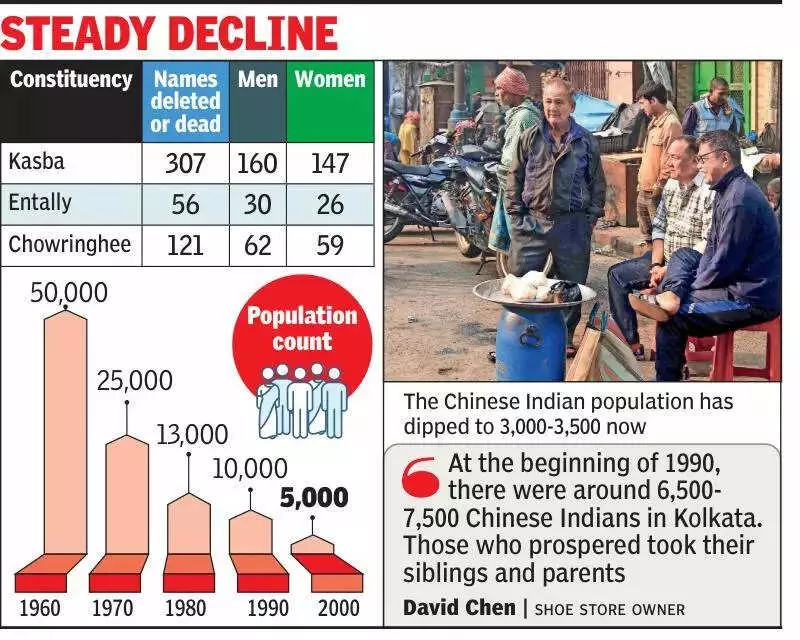
At least 484 Chinese Indians have been deleted from the 2026 draft voter list. These individuals previously appeared on the 2002 voter list for three Assembly constituencies in Kolkata. A shocking 80% of these 484 people could not be traced during the revision process. The remaining individuals have passed away.
Sabar Institute conducted a detailed analysis of the voter rolls. Their study focused on Kasba, Entally and Chowringhee constituencies. The research team identified 252 men and 232 women of Chinese origin who were removed from the lists.

Concentration in Traditional Areas
Three-quarters of the deletions occurred in Chinatown at Tangra. This area straddles both Kasba and Entally constituencies. The remaining 121 deletions came from Tiretta Bazaar, the original Chinatown in Chowringhee constituency.
"Since there is a concentration of Chinese Indians in Tangra and Tiretta Bazaar, we went through the draft roll and picked up Chinese names to conduct the analysis," explained Ashin Chakraborty of Sabar Institute. He worked alongside Souptik Halder and Sabir Ahamed on this revealing study.
Untraceable Individuals and Deaths
Among those who could not be traced were Huang Tung Hsuan, Lee Li Nee Agnes, Ching Nien Kimyaw Hou, Chen Miao Ling, Hui Chiung Chen, Chiu Chin Lien and Chan Choy Yuk. The deceased included Chan Tan Yan, Mei Ling Chen and Wang Liu Chin.
The deletion of names did not spark significant protest within the community. This silence reflects the broader crisis facing Kolkata's Chinese Indian population. Their numbers have dwindled dramatically from 45,000-50,000 in the early 1960s to just 3,000-3,500 today.
Current Distribution and Historical Context
In the two traditional hubs of Tangra and Tiretta Bazaar, the combined Chinese Indian population now stands at approximately 1,000-1,200 people. The remainder have settled in other parts of Kolkata and Howrah, or moved to other Indian cities like Bengaluru, Delhi and Hyderabad.
Restaurateur Monica Liu, born in Kolkata, shared her perspective on this decline. "In the 1960s, there were 45,000-50,000 Indian Chinese in and around Kolkata," she recalled. "The turning point was the Indo-Chinese War in 1962, when the community was branded enemies of the state."
Liu herself spent five years in an internment camp at Deoli in Rajasthan. "After the release, around half the population migrated to other countries that required workers. When I arrived in Kolkata again, the Chinese community was 25,000-30,000 strong," she recounted.
Multiple Waves of Migration
The 1980s brought another wave of migration as people sought better opportunities abroad. "The young generation of Chinese Indians who studied emigrated to the UK, Canada, Australia, Austria and Taiwan, among other countries," said David Chen, owner of shoe store Sen Fo at Bentinck Street.
"At the beginning of 1990, there were around 6,500-7,500 Chinese Indians in Kolkata. Those who prospered also took their siblings and parents," Chen added.
The final significant migration occurred in the 1990s and early 2000s. This followed a Supreme Court order that forced tanneries to shift from Tangra to Bantala. Chinese Indians had traditionally run tanneries in their homes, and living away from their workplace proved challenging.
Establishing tanneries in Bantala required substantial capital. Since few community members filed income tax returns or took loans, they exited the business entirely. "Some tannery owners tried to get into the restaurant business, but many failed. They also moved out," Liu explained.
The voter list deletions serve as a stark numerical reflection of this community's steady decline over decades. What was once a vibrant population of tens of thousands has now reduced to a few thousand, with many traditional strongholds showing dramatic decreases in registered voters.