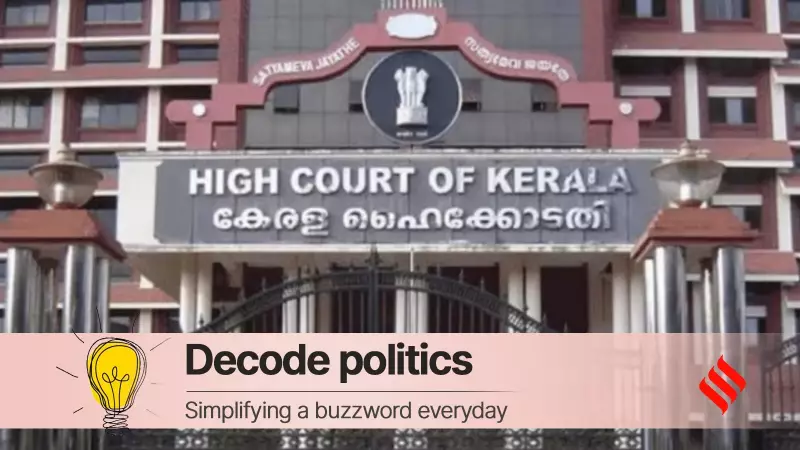
In a significant development for Kerala's political landscape, the Kerala High Court has issued an interim order staying the Election Commission's decision to remove four regional parties from the list of registered unrecognised political parties. The court's intervention comes just ahead of the crucial local body elections in the state.
Court Intervention in Political Party Status
The Kerala High Court, in its order last Thursday, provided immediate relief to four Kerala-based regional parties that had been designated as "delisted RUPPs" by the Election Commission. This interim stay enables candidates from these parties to participate in the ongoing local body elections, potentially altering the political dynamics in various constituencies.
The four parties that received this judicial protection include two factions of the Janadhipathya Samrakshana Samithi (JSS), the Socialist Republican Party, and the Kerala Congress (Skaria Thomas). These political outfits had approached the court challenging the EC's September 19 order that removed them from the official list of registered unrecognised political parties.
Background of the Affected Parties
The Janadhipathya Samrakshana Samithi has a particularly interesting political history. The party was founded by Communist veteran K R Gouriyamma following her departure from the CPI(M) in 1994. Currently, the JSS is divided into two factions - one led by former MLA A N Rajan Babu and the other by Gouriyamma's niece, Dr P C Beenakumari.
This split has led to different political alignments, with Babu's faction joining the Congress-led United Democratic Front (UDF), while the other faction maintains its independent stance. The Socialist Republican Party, established in 1974, has seen limited electoral activity in recent decades, though it contested the Ernakulam seat in the 2014 Lok Sabha elections, finishing in ninth position.
The Kerala Congress (Skaria Thomas) represents a splinter group from the main Kerala Congress formation. The late Kerala Congress veteran Skaria Thomas established this faction in 2015 after leaving the parent organization. Following Thomas's death in 2021, the group has continued its political activities and is currently allied with the CPI(M)-led Left Democratic Front.
Election Commission's Rationale for Delisting
The Election Commission initiated this delisting process as part of a nationwide effort to clean up the electoral system. According to EC guidelines under Section 29A of the Representation of the People Act, 1950, political parties must contest elections within five years of registration and continue participating in elections every six years to maintain their registered status.
The EC identified that these four parties, among 808 RUPPs delisted nationwide, had not contested any Lok Sabha or Assembly elections in the past six years. Furthermore, investigations by the state Chief Electoral Officer revealed that these parties were non-existent at their registered addresses and had failed to comply with conditions prescribed during their initial registration.
Legal Arguments and Court's Reasoning
The petitioners presented several compelling arguments before the Kerala High Court. They emphasized that while they hadn't contested recent parliamentary or assembly elections, they had actively participated in local body polls, including the last elections held in December 2020. This demonstrated their ongoing political engagement at the grassroots level.
The parties also argued that the delisting occurred without proper hearing procedures and that the final delisting order came from the Election Commission rather than the Kerala CEO, who had conducted the initial enquiries and hearings regarding their electoral activity.
The High Court, in granting interim relief, made several significant observations. The court noted that Section 29A of the Representation of the People Act contains no provision for cancellation of a party's registration. The legislation only empowers the Commission to decide whether to register an association as a political party or not to register it.
Furthermore, the court rejected the EC's argument that it could cancel registrations under the Election Symbols (Reservation and Allotment) Order, 1968, describing this position as "unsustainable."
Broader Implications and Future Proceedings
This case extends beyond the immediate fate of these four parties. The Kerala High Court has scheduled further hearing for January 5, 2026, where it will consider the larger constitutional question of whether the Election Commission's plenary powers are "boundless and beyond the purview of judicial review."
The court's eventual ruling could establish important precedents regarding the limits of the Election Commission's authority and the extent to which its decisions can be challenged in judicial forums. This becomes particularly significant given the EC's ongoing efforts to streamline the list of registered political parties across India.
For the affected parties, the interim stay means they can continue enjoying benefits such as entitlement to accept contributions, income tax exemptions, access to common symbols, and preference over Independent candidates on ballots - all crucial advantages in competitive electoral politics.
As Kerala prepares for its local body elections, this judicial intervention ensures that these regional players remain in the political arena, maintaining the diversity of choice for voters while the larger questions about electoral administration and party regulation await resolution in the coming year.