Kerala High Court Intervenes as Sabarimala Reaches 'Breaking Point'
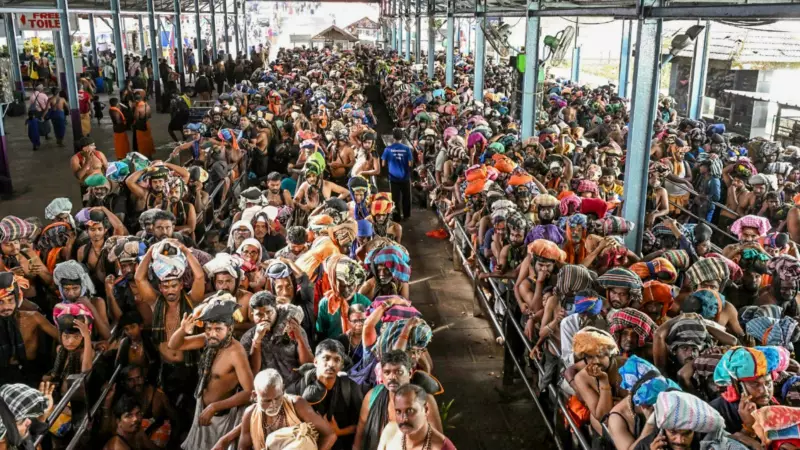
The Kerala High Court took a decisive step on Wednesday, November 20, 2025, by imposing a strict daily cap of 75,000 pilgrims at the renowned Sabarimala temple. This urgent intervention came after the court observed that all available resources at the holy site had reached a breaking point, with authorities struggling to manage the overwhelming influx of devotees.
Unacceptable Risk in the 'Red Zone'
A division bench of Justices Raja Vijayaraghavan and K V Jayakumar, acting on suo motu proceedings concerning crowd management, highlighted the grave dangers of excessive crowding. The bench stated that when the daily pilgrim count exceeded one lakh, the density in certain areas of the temple, particularly the sacred 18 steps and the Pamba–Sannidhanam route, entered the high-risk crush zone. This situation posed an unacceptable threat to public safety, forcing the court to act.
The court's order specifically limits virtual queue bookings to 70,000 and spot bookings to 5,000 pilgrims per day. This directive is set to remain in effect until November 24, providing immediate relief to the strained system. The decision overrides the initial police arrangement that allowed for 90,000 pilgrims (70,000 virtual + 20,000 spot), which had already been breached in the days prior with nearly one lakh devotees arriving.
Systemic Failures and Political Backlash
The crisis has triggered a fierce political storm, with the Opposition Congress and BJP launching a direct attack on the ruling CPI(M) government. They accused the administration of catastrophic failure in crowd management and ensuring basic facilities for the pilgrims.
Opposition Leader V D Satheesan condemned the government, stating, "There is a lack of coordination among various departments. The mismanagement of the pilgrim season is unheard of in the history of the temple. Devotees are struggling to get basic facilities and drinking water." He threatened that the UDF would send a delegation if the situation was not rectified immediately.
Echoing the sentiment, BJP national executive member P K Krishnadas alleged serious human rights violations at Sabarimala. He claimed the state government's primary concern was "smuggling out gold from the temple" and was now taking revenge on the devotees after the scandal was exposed.
A Mandate for Long-Term Solutions
Going beyond the immediate cap, the High Court expressed strong disapproval of the lack of long-term planning. It mandated the Travancore Devaswom Board (TDB) to constitute a permanent Sabarimala Infrastructure and Crowd Management Expert Committee. This committee, comprising specialists from various fields, is tasked with creating a scientific master plan for each pilgrim season. Its work will involve determining the precise carrying capacity of all nodal points and implementing lasting improvements to the facilities.
The court emphasized that this committee is critical to shifting from the current "reactive, repetitive, and fragmented mode of functioning" to a proactive and scientific approach.
In a candid admission, the newly appointed TDB president, K Jayakumar, a retired IAS officer, apologized to devotees who could not have darshan. He pointed out that the new board assumed office just days before the pilgrim season began, and proper preparations should have started at least six months in advance. He highlighted the severe staff shortage, revealing that when one lakh devotees were present, a mere 360 volunteers were available to distribute water.
The situation at Sabarimala serves as a stark reminder of the critical need for robust infrastructure and meticulous planning to ensure the safety and sanctity of one of India's most significant pilgrimage sites.