Across India's states, power follows very different rhythms. In West Bengal, it has stayed remarkably concentrated — just three chief ministers in 50 years, with long, uninterrupted runs defining politics. Tamil Nadu, meanwhile, turned governance into a prolonged battle between DMK and AIADMK (or ADMK), dominated by towering personalities – MG Ramachandran, M Karunanidhi and J Jayalalithaa.
West Bengal: Uninterrupted Dominance
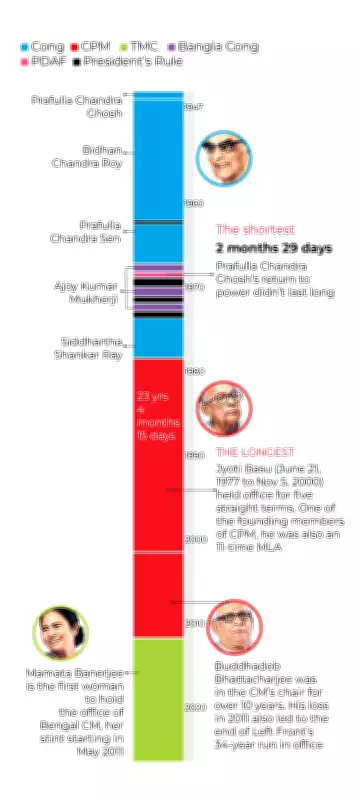
West Bengal's political landscape has been defined by stability and continuity. Over the past five decades, only three chief ministers have held office. Jyoti Basu served from 1977 to 2000, followed by Buddhadeb Bhattacharjee until 2011, and then Mamata Banerjee from 2011 onward. This pattern reflects a deep-rooted loyalty to a single party or leader, with voters rarely shifting allegiance. The state has seen no coalition governments or frequent turnovers, making it a unique case of political concentration in India.
Tamil Nadu: A Prolonged Duel
Tamil Nadu's politics has been a fierce rivalry between two Dravidian parties: the DMK and the AIADMK (now ADMK). This duel has been shaped by charismatic leaders like M. G. Ramachandran, M. Karunanidhi, and J. Jayalalithaa. Since 1967, power has alternated between these two parties, with no third force making a significant breakthrough. The state has witnessed intense personal rivalries and strong regional pride, making elections a high-stakes battle. Even after the demise of key leaders, the duel continues, with the parties now led by successors.

Assam: From Congress to BJP
Assam has transitioned from long-term Congress dominance to a BJP-led phase with more stable tenures. For decades after independence, the Congress party ruled Assam with brief interruptions. However, since the early 2000s, the BJP has gained ground, winning consecutive elections in 2016 and 2021 under Himanta Biswa Sarma. This shift reflects changing demographics, ethnic tensions, and a focus on Hindutva politics. Unlike Bengal, Assam has seen more frequent changes in power, but the recent BJP tenure suggests a new era of stability.
Kerala: The Alternating Coalitions
Kerala stands apart for its near-fixed alternation between two coalitions: the Communist-led Left Democratic Front (LDF) and the Congress-led United Democratic Front (UDF). Since 1980, power has swung between these alliances every few years, with no single party or coalition winning consecutive terms until recently. In 2021, the LDF broke this pattern by winning a second straight term, but the basic rhythm of alternation remains. Kerala's voters are highly politically aware and often vote out incumbents, leading to regular change.
Comparative Analysis
These four states illustrate India's diverse electoral behavior. West Bengal shows long-term single-party dominance; Tamil Nadu features a stable two-party system; Assam exhibits a shift from one dominant party to another; and Kerala demonstrates regular coalition alternation. Each pattern is shaped by historical, social, and cultural factors. Understanding these rhythms is crucial for analyzing national elections, as state-level trends often influence the overall outcome. While some states like Bengal and Tamil Nadu have stable patterns, others like Assam are evolving, and Kerala remains a unique case of political oscillation.