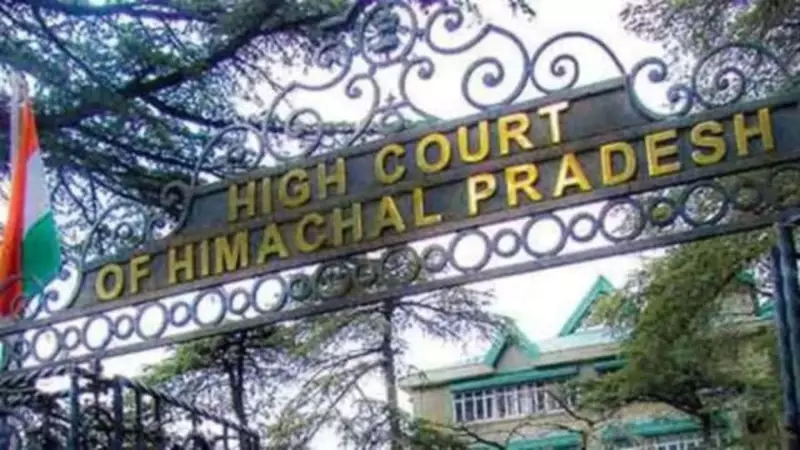
In a significant ruling, the Himachal Pradesh High Court has directed the state government and the State Election Commission (SEC) to ensure the elections to Panchayati Raj Institutions (PRIs) are completed before April 30, 2026. The order, delivered on Friday, comes as a setback to the Congress government led by Chief Minister Sukhvinder Singh Sukhu, which had sought a six-month deferment citing the ongoing Natural Disaster Act and extensive infrastructural damage.
Court Rejects Government's Plea for Delay
A division bench comprising Justices Vivek Thakur and Romesh Verma disposed of a Public Interest Litigation (PIL) challenging the postponement of the polls. The bench directed the Panchayati Raj Department and the SEC to jointly formulate a strategy and complete the entire electoral process by the April deadline.
The state government, in its defence, argued that the Natural Disaster Act was in force due to massive damage to public and private property and rural roads. It pleaded that logistical challenges necessitated at least a six-month delay, stating that even if the reservation roster were issued immediately, a minimum of 90 days would be required.
However, the court observed that to preserve constitutional institutions, elections cannot be postponed indefinitely. It rejected the government's stance, noting that the delay was not justified.
Key Arguments and the Court's Directive
The counsel for the State Election Commission highlighted practical hurdles, noting that census work begins in May and conducting polls during the July-August monsoon would be nearly impossible. Petitioners' advocates argued that the government had over a year to complete delimitation and was using disaster-related reasons as a pretext for deliberate delay.
The bench, after a three-day hearing, issued a clear directive. It ordered the SEC, Panchayati Raj Department, Urban Development Department, and the State Disaster Management Authority (SDMA) to "sit together, decide together and march together" to complete all preparatory processes by February 28, 2026. Subsequently, elections must be conducted within eight weeks, concluding by April 30.
The court designated the State Election Commissioner as the "elder brother" in this exercise, with all other departments acting in aid of the commission. The terms of the state's 3,577 gram panchayats, 90 panchayat samitis, 11 zila parishads, and 71 urban local bodies are ending on January 31, with 50 urban bodies' terms ending on January 18.
Political Reactions: Congress Questions, BJP Celebrates
Chief Minister Sukhvinder Singh Sukhu reacted sharply, stating the high court order needs to be examined vis-a-vis the Disaster Management Act. "We will ask the court whether the Disaster Act has become infructuous and has no meaning," he said. Sukhu claimed the government wanted polls in April-May after board exams and framed the issue as one of legal interpretation of the central Act.
In contrast, the Opposition BJP hailed the verdict as historic. Leader of the Opposition Jai Ram Thakur called it a "victory for democracy," accusing the Congress government of fearing defeat and misusing the Disaster Management Act to throttle democratic processes. He alleged the government had no regard for rules or the Constitution, citing delayed restoration work even seven months after last year's monsoon disaster.
The court's firm directive sets the stage for a rapid election process, emphasizing the constitutional mandate under Articles 243-E and 243-U, which require timely elections to local bodies.