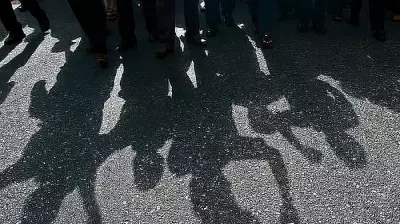
Government employees in Gurgaon took to the streets on Monday, staging a loud protest outside the deputy commissioner's office. They rallied under the banner of the Sarv Karmchari Sangh Haryana, making their voices heard with a clear message for the state government.
Memorandum Submitted with Strike Warning
The protesting workers submitted a formal memorandum to the Haryana government. This document served as an official notice, announcing plans for a nationwide strike scheduled for February 12. Union leaders stated the strike aims to push for several critical demands that affect thousands of employees across departments.
Key Demands of the Protesting Employees
The employees outlined a comprehensive list of grievances. Their primary demands focus on job security and fair compensation. They strongly oppose the increasing privatisation of government functions and the contract system that leaves many workers in precarious positions.

Regularisation of temporary employees stands as a major point of contention. The protestors seek implementation of equal pay for equal work, arguing this principle remains ignored despite court rulings. They demand the restoration of the old pension scheme, which they believe offers better security than newer systems.
Additional demands include filling all vacant posts through permanent recruitment rather than temporary arrangements. Employees also want cashless medical facilities extended across all departments. Those working in hazardous conditions are pushing for proper risk allowances to recognize their challenging work environments.
Leadership and Participation
Basant Kumar, the district president of Sarv Karmchari Sangh Haryana, led the protest at the district headquarters. Sushil Sharma, serving as district secretary, conducted the proceedings, ensuring the demonstration remained organized and focused.
Employees from multiple government departments joined the protest, creating a significant gathering. They raised slogans and displayed placards highlighting their demands related to regularisation, pension benefits, pay parity, and opposition to privatisation.
Court Orders and Government Inaction
Kumar pointed to specific legal decisions that haven't been implemented. "A recent judgment of the Punjab and Haryana High Court directed the regularisation of temporary employees who were excluded under government policies issued in 1993, 1996, 2003 and 2011," he stated.
The court also ordered the creation of an open regularisation policy for temporary employees who completed ten years of service. According to Kumar, the Haryana government has yet to act on these judicial directions, leaving many workers in limbo.
Constitutional and Legal Concerns
The protesting employees raised serious constitutional issues. They alleged non-compliance with Supreme Court rulings on equal pay for equal work, calling this failure a violation of the fundamental right to equality guaranteed by the Constitution.
Recent changes to pension schemes drew particular criticism. Employees opposed modifications made by the Centre to the National Pension System and the Unified Pension Scheme. They demand complete repeal of the Pension Fund Regulatory and Development Authority framework, insisting on restoration of the old pension scheme instead.
Strike Threat Looms Large
The memorandum containing all these demands now sits with the Haryana government, delivered through the deputy commissioner's office. Union leaders issued a stern warning alongside their submission.
They stated clearly that failure to address these longstanding issues will result in the nationwide strike proceeding as announced. February 12 marks their deadline for action, after which coordinated work stoppages could disrupt government functions across the country.
The protest represents growing frustration among government employees who feel their legitimate concerns about job security, fair compensation, and retirement benefits continue to be ignored despite court interventions and repeated appeals.