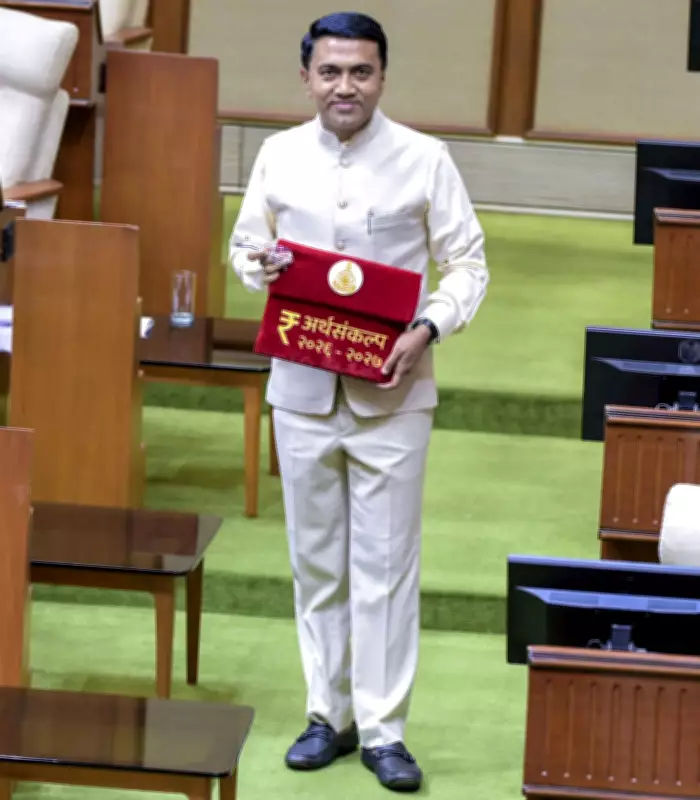
Goa Chief Minister Unveils Election-Oriented Budget for 2026-27
In Porvorim, Chief Minister Pramod Sawant presented a comprehensive fiscal blueprint for the financial year 2026-27, openly acknowledging that the substantial Rs 30,195 crore budget is strategically crafted with the upcoming 2027 state assembly elections in clear view. During his extensive two-and-a-half-hour budget speech, Sawant emphasized the government's commitment to supporting both aspiring young entrepreneurs and elderly citizens requiring palliative care, encapsulated in the message 'Bhivpachi Garaz na' (Do not worry).
Budgetary Allocations and Vision for Viksit Goa 2037
Aligning with the long-term 'Viksit Goa 2037' vision, the budget ensures targeted funding across critical economic sectors. Key areas receiving allocations include:
- Healthcare infrastructure and services
- Women's upliftment and empowerment programs
- Social welfare schemes for vulnerable populations
- Education and skill development initiatives
- Public transportation system enhancements
- Public Works Department (PWD) projects
The financial plan outlines a projected revenue surplus of Rs 1,666 crore, yet Sawant's detailed 80-page speech underscores the state's significant reliance on central government support for fiscal stability.
Heavy Dependence on Central Government Assistance
CM Sawant explicitly detailed Goa's financial dependency, stating, "We expect assistance to the extent of Rs 1,357 crore from Central government for various schemes and an additional Rs 1,600 crore as special assistance from government of India." This reliance is further highlighted by historical data: in the current fiscal year, Goa received approximately Rs 2,078 crore as special assistance for infrastructure development, marking the highest such allocation in the state's history.
To facilitate the effective implementation of these centrally sponsored schemes (CSS), Sawant announced the establishment of a dedicated cell. This unit will focus on preparing detailed project reports (DPRs) for various central sector initiatives, ensuring that budgetary measures translate into tangible outcomes.
Fiscal Management and Borrowing Limits
The strategic leveraging of central funds enables Goa to maintain disciplined borrowing practices. The state has successfully limited its borrowings to just 33% of the Reserve Bank of India's prescribed limit. For the 2026-27 fiscal year, the projected fiscal deficit stands at Rs 3,895 crore, equivalent to 2.9% of the Gross State Domestic Product (GSDP). This figure remains perilously close to the 3% threshold mandated by the Fiscal Responsibility and Budget Management Act (FRBM).
Sawant's proposed fiscal expenditure for the upcoming financial year represents a 3% increase over the Rs 29,200 crore allocated for the year ending March 31. Government revenue projections for FY 2026-27 include Rs 29,181 crore from tax and non-tax sources.
Tax Policies and Revenue Enhancement Measures
In a continuation of previous practices, the budget avoids broad-based tax and fee increases. However, Sawant introduced specific adjustments to excise license fees:
- New excise license fees have been raised to Rs 20 lakh
- Excise license fees for non-Goan applicants have been increased to Rs 25 lakh
Sawant justified these hikes as necessary measures to exercise effective control over the proliferation of new liquor stores, restaurants, and bars across the state. Additionally, to bolster government revenues, the state commercial tax department has been assigned an ambitious target of Rs 6,945 crore through improved compliance mechanisms.
This budget presentation sets the stage for Goa's economic trajectory leading into the crucial 2027 electoral contest, balancing developmental aspirations with pragmatic fiscal management heavily anchored in central support.