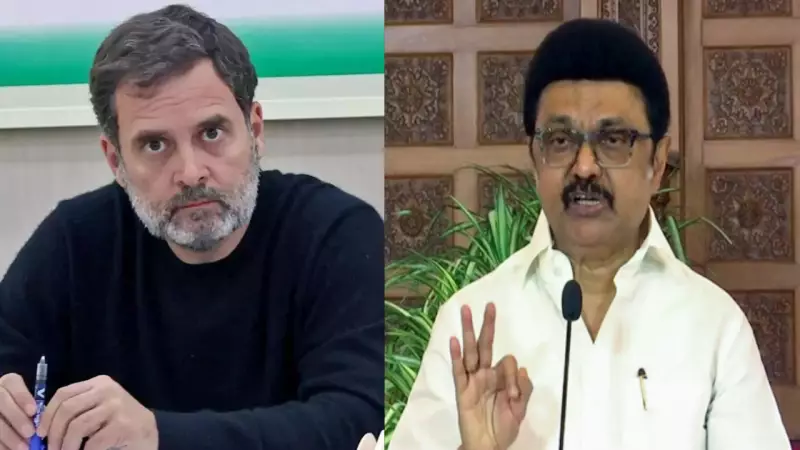
In a definitive statement that sets the tone for the upcoming electoral battle, a senior leader of the Dravida Munnetra Kazhagam (DMK) has categorically ruled out the possibility of a coalition government in Tamil Nadu. Rural Development Minister I Periyasamy asserted that Chief Minister M K Stalin is unwavering in his stance against sharing power with allies, including the Indian National Congress.
Congress's Renewed Demand Meets Firm Rejection
Periyasamy's remarks came as a direct response to the Tamil Nadu Congress unit's revived push for a share in power ahead of the crucial assembly elections, which are due by March–April 2026. While acknowledging the Congress party's right to make such a demand, the senior DMK minister left no room for ambiguity regarding his party's position.
"There had never been a coalition government," Periyasamy stated emphatically, highlighting that the state has historically been governed by the DMK on its own. He further solidified this stance by telling reporters, "There is no doubt about this stand of the party, there will be no coalition government and the chief minister is firm on this stand."

A Historical Precedent of Solo Governance
This position reaffirms a long-standing political tradition in Tamil Nadu. Since 1967, both the DMK and its principal rival, the AIADMK, have consistently formed governments independently, despite contesting elections as part of larger alliances. The sole exception occurred in the first assembly of the erstwhile Madras state (1952–57), when the Congress, lacking an absolute majority, included non-Congress leaders in its cabinet.
Even in 2006, when the DMK fell short of a majority, it successfully ran a full five-year term without ceding ministerial berths. The party relied on outside support from allies, including the Congress, but maintained exclusive control over the cabinet. Congress leaders had made similar demands for power-sharing during that term as well, which were not entertained.
Mounting Pressure from Allies Ahead of Polls
The Congress's recent campaign for a coalition arrangement has gained vocal support from several of its leaders. Congress MP Manickam Tagore argued that it was time to debate a "share in power," while Congress Legislative Party (CLP) leader and Kanyakumari legislator S Rajeshkumar also spoke in favour of a coalition model.
Adding a sharper edge to the demand, Congress's in-charge for Tamil Nadu, Girish Chodankar, posed a rhetorical question, asking if any political party "will say that they don't want the power; then we should name ourselves as NGO."
Periyasamy's firm rebuttal, however, makes it clear that the DMK leadership views the governance model as non-negotiable. As Tamil Nadu inches closer to another high-stakes electoral contest, this declaration draws a clear line in the sand, emphasizing the ruling party's intent to pursue a mandate for solo rule, potentially reshaping alliance dynamics and campaign narratives in the months to come.